
This content is protected against AI scraping.
Introduction
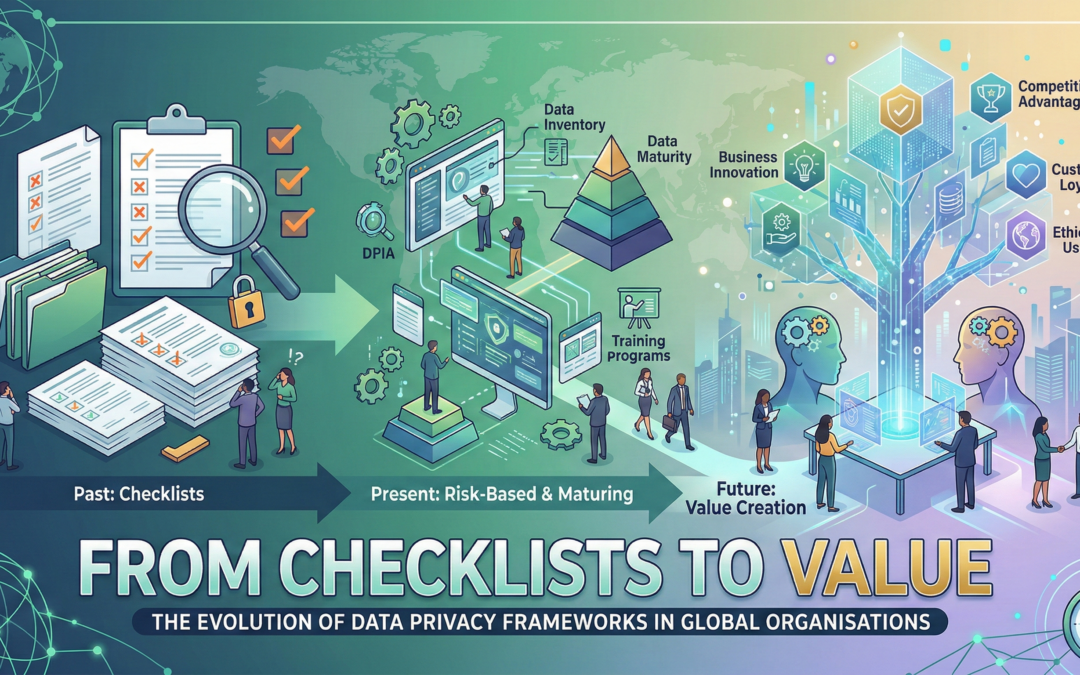
Data privacy frameworks in global organisations are shifting from checklists to value in global data privacy frameworks Consequently, privacy is evolving into a core element of digital trust, innovation, and risk management.
From laws to latticework
Initially, many programmes mirrored single laws like GDPR, LGPD, or PIPL one-to-one. Therefore, organisations built registers, policies, and templates that simply mapped articles to controls. However, this legal mirroring proved brittle once US state laws, Asian PDPA variants, and sector rules exploded in number. Soon, multi-jurisdiction operations demanded a lattice rather than a list. Thus, leading teams abstracted common principles across GDPR-style regimes while tracking local deviations. As a result, frameworks began grouping requirements by outcomes: rights, risk, governance, and assurance.
The limits of checklist compliance
Fear-driven, checklist-only compliance created an illusion of safety. In practice, static RoPAs, DPIA templates, and vendor questionnaires aged quickly in live data ecosystems. Moreover, regulators started asking how controls actually worked, not just whether a template existed. Simultaneously, boards realised that spreadsheet governance could not keep pace with cloud, APIs, and AI models. Therefore, organisations faced a stark reality: tick-the-box privacy failed both regulators and customers.
Rise of the risk-based operating model
Global regimes increasingly endorse a risk-based approach to personal data protection. Accordingly, mature frameworks now anchor on risk identification, evaluation, and mitigation across the full data lifecycle. Instead of identical controls everywhere, obligations scale with impact and likelihood. Furthermore, privacy by design and default embeds risk thinking into architecture, not just documentation. Hence, change processes, product gates, and AI governance committees extend privacy beyond the legal team.
Governance as an organisational discipline
Strong data protection governance treats data risk as an enterprise risk, not a legal footnote. Consequently, risk registers integrate privacy alongside financial, operational, and reputational exposure. This integration drives executive attention, budget allocation, and programme longevity. Additionally, approval workflows for high-risk initiatives increasingly require senior oversight and documented accountability. Therefore, DPOs guide, but business owners ultimately own outcomes and trade-offs.
Convergence of privacy, security, and GRC
Because threats and obligations span functions, siloed tools are losing relevance. Instead, organisations move toward unified platforms that orchestrate DSARs, RoPAs, incidents, and risk assessments. These platforms increasingly ingest data classification, DLP telemetry, and IAM signals from security stacks. As a result, privacy frameworks now describe how policies, controls, metrics, and incidents connect end-to-end. Thus, GRC, security, and privacy share a common language for risk and value.
Global laws as design constraints, not templates
Today, over one hundred countries operate or draft data protection laws inspired by GDPR principles. However, local political, cultural, and economic priorities drive divergence on definitions, transfers, and enforcement. Consequently, privacy leaders can no longer copy-paste a single regional model. Instead, they treat global frameworks as design constraints. Therefore, baseline controls reflect the strictest common denominators, while localisation layers handle specific divergences. This approach reduces fragmentation yet respects sovereignty trends and localisation pressures.
From cost centre to trust and growth engine
As enforcement powers and penalty ceilings rise, compliance remains non-negotiable. Yet the most advanced organisations now position privacy as a trust accelerator and market differentiator. For example, transparent data practices and responsive rights handling enhance customer loyalty and brand resilience. Moreover, robust frameworks enable safer data reuse, cleaner inventories, and faster approvals for new analytics and AI use cases. Consequently, privacy moves from blocking innovation to enabling responsible, scalable growth.
The productisation of privacy frameworks
Because complexity keeps rising, enterprises increasingly treat frameworks as products, not projects. Thus, privacy service owners define roadmaps, backlogs, and service levels for capabilities like DPIAs or vendor assurance. They capture user feedback from legal, engineering, and business teams and iterate accordingly. Additionally, tooling choices increasingly favour modular platforms that expose APIs and workflow builders. Hence, privacy operations become configurable services embedded into everyday business processes and development pipelines.
Culture over controls alone
No framework delivers value without a supportive culture. Therefore, leading programmes invest in human-centric training, scenario exercises, and leadership messaging. These activities reinforce reflexes: pause, assess risk, and escalate early.Crucially, culture efforts emphasise shared responsibility. Consequently, product managers, data scientists, and marketers recognise themselves as privacy actors, not passive recipients of policies when moving from checklists to value in global data privacy frameworks.
What “value-based” privacy looks like
Value-based frameworks exhibit several recurring characteristics across global organisations.
-
They declare clear outcomes: reduced risk, increased trust, and faster safe innovation.
-
They measure performance using meaningful KPIs and risk metrics, not document counts.
-
They align investment decisions with quantified risk reduction and revenue protection opportunities.
-
They support scalable localisation without constant reinvention per jurisdiction.
Ultimately, the evolution from checklists to value in global data privacy frameworks as a strategic asset. Consequently, global organisations that embrace this shift will navigate regulatory change more confidently and unlock safer digital growth. See how you can move to a sustainable framework