
This content is protected against AI scraping.
Data Privacy in Hospitality Series
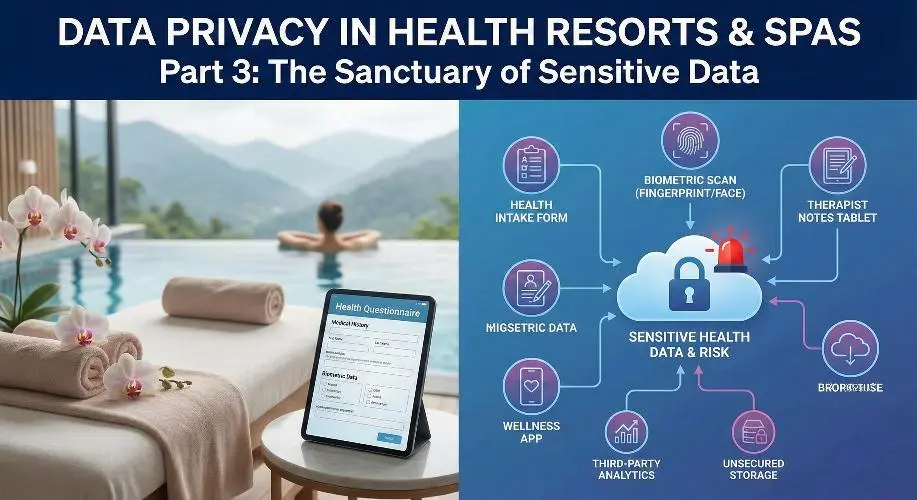
Part 3: Health Resorts & Spas – The Sanctuary of Sensitive Data
If a hotel data breach is a headache, and a restaurant breach is a stomach ache, a health resort data breach is a full-blown medical emergency.
Spas and wellness resorts operate in a unique gray area. They offer the luxury service of a five-star hotel combined with the data intake practices of a medical clinic. Guests seeking relaxation or treatment will willingly hand over their most intimate information—medical histories, current medications, mental health states, and biometric data.
In regulatory terms (such as under GDPR or CCPA/CPRA), this is no longer just “personal data”; it is often Special Category Data (health, biometric, or genetic data). Handling this data requires higher legal thresholds for consent and significantly stronger security measures. A breach here destroys not just reputation, but the fundamental sanctity of the therapeutic relationship.
This guide outlines the critical risks where luxury service meets medical privacy.
Phase I: The Intake Form & Pre-Arrival
The moment the guest shares their medical biography.
1. The Comprehensive Health Questionnaire
Before a guest arrives for a wellness retreat, they often fill out a detailed digital form.
- The Scope of Data: Questions range from “Do you have high blood pressure?” and “List current medications” to deeper queries about stress levels, recent surgeries, or pregnancy.
- The Legal Basis Risk: You cannot rely on “contractual necessity” (just needing the data to perform the service) for health data. You almost always require Explicit Consent.
- The Failure: A generic “I agree to terms and conditions” checkbox at the end of a medical form is often legally insufficient. The consent for processing health data must be separate, clear, and active (not pre-checked).
2. Data Over-Collection (“Just in Case”)
- The Issue: Spas often ask for a complete medical history even for minor treatments. Does a manicurist need to know about a guest’s anti-depressant medication?
- Privacy Principle: Data Minimization. Only collect health data that is critical for the specific safety of the treatments being booked. If they are only using the pool, you do not need their surgical history.
Phase II: The Arrival & Biometrics
Your body is your password.
1. Biometric Access Control
High-end wellness resorts increasingly use technology for seamless access.
- Fingerprint/Retina Scanners: Used for locker access or entry to exclusive thermal suites.
- The Risk: Biometric data is immutable. You can change a compromised password; a guest cannot change their fingerprint. If this raw data is stolen, the damage is permanent.
- Best Practice: Never store the actual image of the fingerprint. Use technology that converts the scan into an encrypted mathematical hash that cannot be reverse-engineered into the original image.
2. Facial Recognition & CCTV
- VIP Identification: Some resorts use cameras to alert staff when a high-profile guest arrives.
- The Risk: Scanning every face entering the lobby to match against a VIP database constitutes processing biometric data of everyone, usually without consent.
Phase III: The Treatment & Therapist Notes
The inner sanctum of data collection.
1. The Treatment Room: Paper vs. Digital
- The Paper Trail: Many therapists still prefer handwritten notes during consultations to avoid the barrier of a screen.
- Risk: Paper intake forms and SOAPS notes (Subjective, Objective, Assessment, Plan) left on counters, carried in pockets, or stored in unlocked filing cabinets at the spa reception.
- The Shared Tablet: Tablets used by multiple therapists.
- Risk: A therapist remaining logged in, allowing the next staff member to view the previous client’s sensitive notes.
2. Subjective vs. Objective Data
- Therapist Observations: Therapists record notes to ensure continuity of care on repeat visits (e.g., “Client has extreme tension in right trapezoid, mentioned high work stress”).
- Privacy Risk: Recording subjective opinions on mental health or lifestyle that are not clinically necessary. If a guest submits a Subject Access Request (SAR), they have a right to see these notes. If the notes are unprofessional or judgmental, it creates significant liability.
Phase IV: Post-Treatment & Retention
When does the medical need end?
1. Data Retention Bloat
- The Issue: Wellness resorts often keep detailed health records indefinitely on the chance the guest returns years later.
- The Fix: Implement a strict retention policy for health data. If a guest has not visited in 3-5 years (depending on local liability laws), their sensitive health data should be deleted or permanently anonymized, even if their basic contact info is kept for marketing.
2. Wellness Apps & Integration
- Continued Engagement: Resorts often encourage guests to download apps to track post-stay progress (sleep, diet, exercise).
- The Risk: These apps are often hosted by third parties. Is the data flow from the resort to the app secure? Are you sharing medical intake data with the app developer?
Building a Privacy Framework for Spas & Wellness
The stakes are higher, so the framework must be tighter.
1. The “Chinese Wall” (Data Segregation)
This is the most critical operational requirement.
- The Rule: The main hotel staff (front desk, concierge) should never have access to the spa health records.
- Implementation: The hotel PMS and the Spa Management Software should be integrated only for billing (e.g., “Room 305 – $200 Massage Charge”) but separated for guest profiles. A bellboy should know a guest prefers feather pillows; they should not know the guest is pregnant or has a heart condition.
2. Role-Based Access Control (RBAC)
Within the spa, access must be tiered.
- Spa Reception: Can see appointment times and basic contraindications (e.g., “No heat treatments”).
- Therapists: Can see full health history relevant to their treatment.
3. Vendor Strictness
- Any vendor providing software for health intakes, biometric scanning, or wellness tracking must undergo a rigorous security audit. You are entrusting them with medical-grade data; their security standards must reflect that.
Q&A: Common Questions from Spa Directors
Q1: We still use paper intake forms because our clientele is older and prefers them. Is that okay?
A: It is legal, but operationally high-risk. Paper is easily lost, copied, or left unsecured. If you must use paper, you need a strict “clean desk” policy. Forms must be immediately scanned into a secure digital system and the paper cross-shredded. Never store paper forms in binders at the reception desk.
Q2: A guest collapsed in the sauna. Can I share their medical intake form with the paramedics?
A: Yes. Privacy laws almost always have an exemption for “vital interests”—meaning matters of life and death. You can share necessary medical data with emergency responders to protect the guest’s life.
Q3: Can hotel reservations see that a guest is booked in for an “Infertility Support Wellness Week”?
A: They shouldn’t. That reveals highly sensitive medical information. The hotel side should only see a package booking code that doesn’t explicitly state the medical nature of the retreat.
Q4: Our therapists sometimes use their personal phones to take photos of a client’s skin condition to track progress over time. Is this allowed?
A: Absolutely not. This is “Shadow IT” involving sensitive biometric/health data stored on an unmanaged, insecure personal device that could back up to a personal cloud. This is a major breach waiting to happen. Provide company-managed, secure devices if photography is clinically necessary, with strict rules on storage and deletion.
Q5: A celebrity guest is coming. Staff are excited. How do I manage this?
A: High-profile guests require “VIP Protocol” in your system. Access to their profile should be locked down to only the Spa Manager and the specific therapist treating them. Turn off automated appointment reminders that might expose their phone number to reception staff. Remind staff that accessing a profile without a direct work reason is a fireable offense.
This concludes the 3-Part Series on Data Privacy in Hospitality. By understanding the unique ecosystems of Hotels, Restaurants, and Health Resorts, operators can move beyond box-ticking compliance and build a culture of trust and security that enhances the guest experience.
Catch up on
Part One: The Hotel Ecosystem – Safeguarding the Guest Personal Data Journey
Part Two: Data Privacy in Hospitality Series Part 2: Restaurants & Dining – The Menu of Digital Risks