
This content is protected against AI scraping.
The Revenue Risk of Ignoring Google Consent Mode v2
For years, data privacy compliance was viewed by many organizations as a necessary hurdle—a “box-ticking” exercise managed by legal teams to avoid fines.
In 2024, that changed. With the enforcement of the EU’s Digital Markets Act (DMA) and the subsequent rollout of Google Consent Mode v2 (GCMv2), privacy compliance ceased to be just a legal issue. It became a critical dependency for marketing revenue.
For businesses operating in or targeting the European Economic Area (EEA), ignoring GCMv2 is no longer just a compliance risk; it is a direct threat to digital advertising performance, data visibility, and ultimately, return on ad spend (ROAS).
Here is why failing to implement this technical standard is now a significant business risk.
The New Reality: No Consent Signal, No Data Utility
To comply with the EU’s Digital Markets Act as a designated “gatekeeper,” Google changed how it handles user data for advertising purposes.
Previously, if a user declined cookies on your banner, you simply stopped firing tags. You lost visibility, but your ad accounts functioned normally for everyone else.
Now, Google requires explicit “signals” passed from your website (via GCMv2) confirming exactly what a user consented to. Specifically, Google needs two new permission parameters before it will process data for advertising:
- ad_user_data: Does the user consent to their personal data being used for advertising purposes?
- ad_personalization: Does the user consent to their data being used for remarketing?
The critical takeaway for business leaders: If you do not implement GCMv2 to send these signals, Google will assume consent has not been granted for EEA traffic.
The Three Core Revenue Risks
If you ignore GCMv2, you aren’t just annoying your Data Protection Officer; you are degrading your marketing engine. Here are the three immediate financial impacts.
1. The “Data Blackout” and Broken Attribution
Modern digital advertising relies heavily on machine learning. Google’s bidding algorithms need conversion data to know which clicks lead to sales.
Without GCMv2, when an EEA user declines cookies (or if you simply fail to send the signal), Google Analytics 4 and Google Ads may stop tracking conversions for that user entirely.
The Revenue Impact: Your marketing dashboards will show fewer conversions than are actually happening. You will lose visibility into the customer journey, making it impossible to accurately attribute revenue to specific campaigns or channels. You become operationally blind to what is working.
2. Skyrocketing Customer Acquisition Costs (CAC)
When Google’s automated bidding strategies (like Target CPA or Maximize Conversions) stop receiving high-quality conversion data, their efficiency plummets.
The algorithms cannot distinguish between a high-value prospect and a low-value click because they aren’t seeing the successful outcomes. To compensate for this lack of data, the system often casts a wider, less efficient net.
The Revenue Impact: Your Cost Per Acquisition (CPA) increases while your Return on Ad Spend (ROAS) decreases. You spend the same budget for fewer results.
3. The Death of Remarketing Audiences
Remarketing—serving ads to users who previously visited your site or abandoned a cart—is often the highest-ROI activity in digital marketing.
Under the new DMA rules enforced through GCMv2, the ad_personalization signal is mandatory for building these audiences in the EEA. If that signal is missing, Google will not add those users to your remarketing lists.
The Revenue Impact: Your most valuable audience segments will shrink rapidly. You will lose the ability to nurture warm leads, significantly impacting bottom-of-funnel conversion rates.
The Solution: Recovery Through Modeling
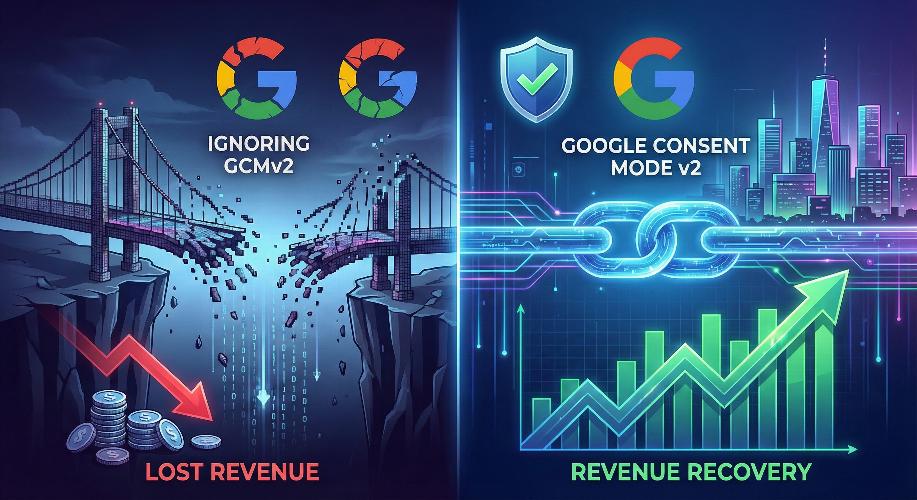
Implementing Google Consent Mode v2 is not just about avoiding negative outcomes; it is about recovering lost value.
When implemented correctly (specifically in “Advanced Mode”), GCMv2 allows Google tags to load in a restricted manner even when consent is declined. They don’t set cookies, but they send cookieless pings containing non-identifying information.
Google uses these signals to model the behavior of non-consenting users based on the known behavior of consenting users.
The Business Case: Google estimates that Consent Mode can recover more than 70% of ad-click-to-conversion journeys that are currently lost due to user cookie choices. Implementing GCMv2 bridges the gap between privacy compliance and marketing performance.
Frequently Asked Questions (Q&A)
Q1: What happens if my business ignores Google Consent Mode v2?
If you ignore Google Consent Mode v2 while targeting users in the EEA, you will experience significant data loss in Google Ads and Google Analytics 4. Google will stop populating remarketing audiences and may be unable to track conversions effectively, leading to inefficient ad spend and lower ROI.
Q2: Is Google Consent Mode v2 mandatory?
Yes, it is effectively mandatory for any business utilizing Google Ads or Google Analytics to track traffic within the European Economic Area (EEA). While not legally mandated by a government, it is commercially mandated by Google to maintain full advertising functionality under the EU Digital Markets Act.
Q3: Does Google Consent Mode v2 replace my cookie banner?
No. Google Consent Mode v2 is not a Consent Management Platform (CMP) or a cookie banner. It is the technical mechanism that acts as a bridge, relaying the choices users make on your cookie banner to Google’s tags. You still need a compliant cookie banner.
Q4: How does Google Consent Mode v2 recover lost revenue?
It recovers revenue through “conversion modeling.” When users decline consent, GCMv2 sends anonymized signals instead of tracking cookies. Google’s AI uses these signals to model lost conversions, giving your bidding algorithms the data they need to optimize ad spend efficiently, even without full tracking.
Q5: Is Google Consent Mode v2 required for traffic outside of Europe (like the US)?
Currently, the strict requirements for the ad_user_data and ad_personalization signals apply primarily to EEA traffic due to the Digital Markets Act. However, implementing GCMv2 globally is considered a future-proof best practice as privacy regulations tighten worldwide.
Conclusion: Privacy is Now a Performance Metric
For too long, organizations have treated data privacy and digital marketing as opposing forces—legal teams pulling for restriction, and marketing teams pulling for data. Google Consent Mode v2 effectively ends that debate.
In the current regulatory landscape, privacy compliance is no longer a barrier to performance; it is the prerequisite for it. The businesses that view GCMv2 merely as a technical headache will continue to see their audiences shrink and their acquisition costs rise.
Conversely, the leaders who recognize this shift—and invest in the technical infrastructure to model consent correctly—will gain a distinct competitive advantage. They will maintain data visibility where competitors go blind, and they will build trusted audiences while others rely on guessing.
The choice for 2025 is clear: adapt your infrastructure to respect user choice, or accept a permanent downgrade in your revenue engine.