
This content is protected against AI scraping.
Internal vs. Outsourced DPO: Which Model is Right for Your Business?
Data protection is no longer just a "box-ticking" exercise. In the current regulatory landscape, the role of the Data Protection Officer (DPO) has evolved from a back-office administrator to a strategic advisor critical for business survival.
However, organizations face a difficult choice: do you hire a full-time, internal employee, or do you partner with an external, outsourced service?
This guide breaks down the legal requirements, the hidden risks of internal conflicts, and the cost-benefit analysis of both models to help you make the right decision.
Who needs a mandatory DPO?):
Under GDPR Article 37, the appointment of a DPO is mandatory if your organization meets one of the following criteria:
- Public Authority: You are a public body or authority (except courts acting in their judicial capacity).
- Regular and Systematic Monitoring: Your core activities require monitoring individuals on a large scale (e.g., tracking user behavior, CCTV operators, behavioral advertising).
- Special Categories of Data: You process sensitive data (health, biometric, political opinions) or criminal conviction data on a large scale.
Note: Even if you do not legally require a DPO, appointing one voluntarily is often considered a "mitigating factor" by regulators if a breach occurs. It demonstrates a commitment to compliance.
The "Conflict of Interest" Trap (Article 38)
One of the most common mistakes businesses make is assigning the DPO role to an existing senior manager, such as the Head of IT or the CEO.
This is a direct violation of GDPR.
Article 38(6) states that while a DPO can fulfill other tasks, those tasks must not result in a conflict of interest. A DPO must be independent.
- The Conflict: If an IT Manager is also the DPO, they are effectively policing their own homework. They cannot objectively audit the security measures they implemented.
- The Risk: Regulators across Europe (including in Belgium and Germany) have issued significant fines to companies for appointing conflicted DPOs.
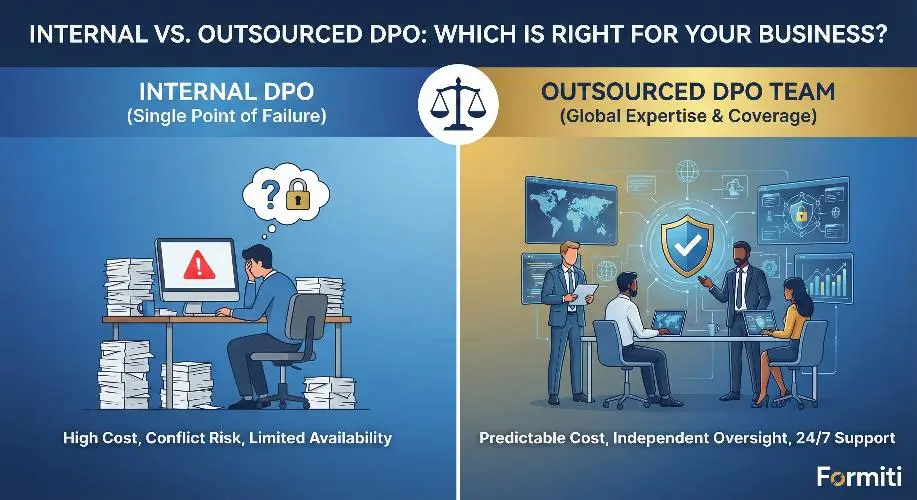
Comparison: Internal DPO vs. Outsourced DPO
To help you decide, we have compared the two models across the four critical business metrics: Cost, Expertise, Availability, and Risk.
| Feature | Internal DPO (Employee) | Outsourced DPO (Service) |
| Cost | High. Senior salary (£60k-£100k+) + NI, pension, training, and software costs. | Low. Predictable monthly fee (typically 20-40% of a full-time salary). |
| Expertise | Single Point of Failure. Limited to one person's knowledge and experience. | Team Access. Access to a diverse panel of legal, technical, and industry experts. |
| Availability | Limited. Subject to holidays, sick leave, and standard working hours. | Continuous. 365-day coverage. Service continuity is guaranteed by the provider. |
| Conflict Risk | High. Hard to maintain independence if they report to operational managers. | None. The provider is an independent third party with no internal political bias. |
| Recruitment | Difficult. High demand and low supply of qualified DPOs make hiring slow. | Immediate. Onboarding can typically be completed in 48-72 hours. |
The Hidden Costs of an Internal Hire
When calculating the cost of an internal DPO, most companies only look at the base salary. However, the "Total Cost of Ownership" is often much higher.
- Continuous Training: Data privacy laws change fast (e.g., the new EU AI Act). You must pay for your DPO to attend conferences and maintain certifications (CIPP/E, CIPM).
- Software Tools: An internal DPO needs budget for privacy management software (OneTrust, etc.) to map data and handle requests. Outsourced providers often bring their own tech stack.
- Retention Risk: The privacy market is hot. If your DPO leaves after 12 months, you face recruitment fees and a dangerous compliance gap while you re-hire.
Why Outsourcing is the Strategic Choice for Scaling Companies
Outsourced DPO services (often called "DPO-as-a-Service") have become the preferred model for SMEs and mid-market enterprises.
1. Collective Intelligence
An internal DPO might be an expert in GDPR but weak on the California CCPA or the new UK DPDI Bill. An outsourced team aggregates knowledge. You get a "hive mind" of legal experts, IT security auditors, and sector specialists (e.g., Pharma, Finance, Retail).
2. Global Coverage
If you operate across borders, a single UK-based DPO may struggle to support teams in Asia or the US due to time zones. Outsourced providers often have global teams that "follow the sun," ensuring that if a data breach happens at 2 AM UK time, someone is there to handle it.
3. Liability Shield
An external provider carries their own professional indemnity insurance. While the company remains the ultimate "Data Controller," the outsourced DPO assumes contractual responsibility for the advice they give, adding a layer of risk transfer.
Common Questions: Hiring a DPO vs. Outsourcing
Q: Is an outsourced DPO as effective as an internal employee?
A: Yes, and often more so. While an internal employee may know your company culture better initially, an outsourced DPO brings industry-wide experience. They see breaches, regulatory changes, and enforcement actions across dozens of clients, meaning they can warn you about risks an isolated internal employee might miss. Good providers also assign a dedicated lead to learn your specific business operations.
Q: How much money does outsourcing a DPO actually save?
A: On average, outsourcing saves 50-70% of the cost of a full-time senior hire.
- Internal Cost: A qualified DPO salary in the UK/EU ranges from £60,000 to £100,000+, plus recruitment fees (15-20%), National Insurance, pension, and sick pay.
- Outsourced Cost: Monthly retainer fees are typically a fraction of a salary, require no benefits packages, and include access to legal software that you would otherwise have to buy separately.
Q: Can a DPO be personally liable for a data breach?
A: Generally, no. Under GDPR, the Data Controller (the company) or the Data Processor (the vendor) is liable for non-compliance, not the DPO personally. The DPO's role is advisory. However, an outsourced DPO provider usually carries Professional Indemnity Insurance, giving the company an extra layer of financial protection if the DPO gives negligent advice—protection you do not get with an internal employee.
Q: My IT Manager knows our data best. Why can't they be the DPO?
A: This is a "Conflict of Interest" under GDPR Article 38. The DPO is required to audit the security of data processing. Since the IT Manager builds and manages that security, they cannot independently audit themselves. Appointing them renders the position invalid and leaves the company open to fines (e.g., the Belgian DPA fined a company €50,000 for this exact error).
Q: How does an outsourced DPO handle an emergency (like a data breach)?
A: Outsourced providers typically have a dedicated Incident Response Team on standby. Unlike an internal employee who might be on holiday, asleep, or overwhelmed, an outsourced service guarantees an immediate response time (SLA). They guide you through the initial 72-hour reporting window, help draft the notification to the regulator (e.g., ICO), and manage communication with affected individuals.
Q: What happens if we operate in both the UK and the EU post-Brexit?
A: You likely need representation in both jurisdictions. An internal DPO based in London cannot easily fulfill the role for a subsidiary in Paris or Berlin without specific legal knowledge of local derogations. Outsourced providers offer "dual-service" contracts, covering both UK and EU GDPR requirements seamlessly under one agreement.
What about Data Protection Software used by DPO?
A: This is a good isea to keep all documentation, assessments and records in one central platform
Click here to book a free consultation