
This content is protected against AI scraping.
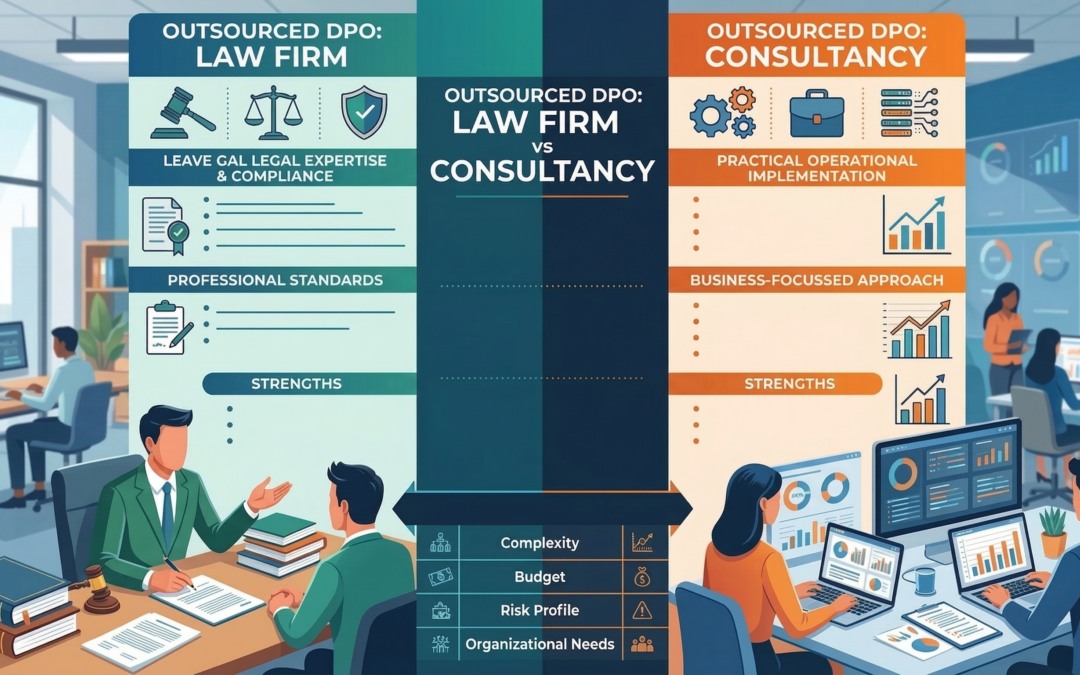
Choosing between an outsourced DPO law firm vs consultancy is ultimately about balancing legal firepower with operational capability, because while law firms excel at high‑stakes contracts and defence, a specialist privacy consultancy brings the day‑to‑day governance, tooling, and global regulatory coverage most organisations actually need.
What law firms do well
Law firms remain exceptionally strong where the primary need is legal interpretation, risk positioning, and defence.
-
Contract drafting and negotiation: Commercial and technology law teams excel at crafting Data Processing Agreements, liability clauses, SCCs and complex transaction documents, ensuring the organisation’s contractual risk position is robust in M&A, vendor negotiation, or joint controller scenarios.
-
Litigation and investigations: When there is a data breach, contentious DSAR, regulatory investigation, or potential class action, law firms are designed to form a legal defence, manage privilege, and handle dispute resolution end‑to‑end.
-
Point‑in‑time advice: Law firms typically engage on defined matters or projects, delivering legal opinions, drafting, or red‑line support rather than running the continuous operational compliance programme.
Where law firms are less suited as DPO/Representative
Using a law firm as DPO or EU/UK representative can create structural gaps when the role requires hands‑on, operational oversight rather than purely advisory work.
-
Operational implementation limits: Professional DPOs are expected not only to know the law but to embed it into processes, DPIAs, ROPAs, training, and daily decision‑making; many lawyers lack the operational playbooks, templates, and change‑management experience to do this at scale.
-
Narrow jurisdictional focus: Even where a firm has strong GDPR expertise, it may have limited depth in non‑home regimes such as Thailand PDPA, India’s DPDP Act, or sector‑specific life sciences rules, which increasingly shape global privacy risk.
-
Lone‑advisor model: A single senior solicitor billing by the hour can become a bottleneck and a single point of failure, making it hard to provide continuous monitoring, incident rehearsal, and proactive programme development across multiple business units and countries.
Strengths of specialist privacy consultancies
A mature privacy consultancy is built around operationalising compliance, particularly where global footprints and complex processing activities are involved.
-
Embedded, ongoing DPO role: Outsourced DPO providers act as the official point of contact, oversee DPIAs, maintain ROPAs, drive training and awareness, and coordinate DSAR and breach response using standardised methods and tooling, rather than ad‑hoc opinions.
-
Multi‑jurisdictional and cross‑functional expertise: Global consultancies blend legal, regulatory, and technical skills and are often structured to cover GDPR, UK GDPR, and emerging frameworks like Thailand PDPA and India’s DPDP Act for clients operating in 100+ countries.
-
Team‑based delivery instead of lone wolf: Instead of one DPO trying to do everything, leading consultancies deploy pods of privacy, legal, and operational specialists working together, giving clients the effect of a full privacy office without multiple FTE hires.
Balanced view: law firm vs consultancy
Both models have clear strengths; the question is how they align with your risk profile, operating model, and geographic reach.
-
Strategic alignment: Law firms are ideal where the primary risk is contentious—regulatory investigations, disputes, or complex negotiations—whereas consultancies are better aligned to organisations needing sustained programme build‑out, documentation, and “privacy by design” across products and projects.
-
Role of EU/UK representative: EU and UK rules explicitly allow either law firms or consultancies to act as representatives, but the underlying expectation is a body that understands the law, the local supervisory authority culture, and the organisation’s actual practices in multiple languages and jurisdictions.
-
Hybrid governance: Many organisations benefit from a combined model in which an operational DPO consultancy handles day‑to‑day compliance and regulator liaison, while specialist law firms are retained for privileged advice, escalation, and high‑stakes negotiation or litigation.
Formiti’s “Power of Three” outsourced DPO model
Formiti’s global outsourced DPO model illustrates how a team‑based consultancy can complement and outperform the lone‑wolf paradigm in complex, international environments. Rather than assigning a single individual, Formiti provides each client with a named DPO supported by three specialised teams covering legal, privacy architecture, and operational delivery across more than 120 jurisdictions.
-
Legal team: Focuses on interpreting evolving laws (GDPR, UK GDPR, Thailand PDPA, India DPDP Act and others), aligning positions with external counsel, and ensuring that policies, records, and data transfer mechanisms are defensible under regulatory scrutiny.
-
Privacy team: Designs and maintains the governance framework—DPIA libraries, RoPA standards, consent and transparency patterns, training pathways, and sector‑specific controls for high‑risk areas like life sciences and clinical research.
-
Operations team: Embeds processes into business units, runs DSAR and incident workflows, coordinates with IT and security, and ensures evidence‑based accountability through ongoing monitoring and reporting, rather than one‑off projects.
For organisations deciding between appointing a law firm or a consultancy as DPO or EU/UK representative, this “Power of Three” structure shows a pragmatic route: law firms remain essential strategic partners for contracts and disputes, while a global, team‑based outsourced DPO like Formiti provides the scalable operational backbone needed to stay compliant, audit‑ready, and commercially agile in a rapidly evolving regulatory landscape