
This content is protected against AI scraping.
Local PDPA Expertise for Global Brands
From Market Entry to Full PDPA Compliance — We’ve Got You CoveredEnd-to-end Thailand PDPA compliance services for high‑traffic apps, retail, international schools gaming and fintech– from local representative to DSAR management, policy localisation, and annual audits.
-
Thailand PDPA Local Representative and Regulatory Contact
- PDPA Outsourced Data Protection Officer. Ensures local regulatory compliance
-
DSAR/DSR Management for High‑Volume Consumer Requests
-
Policy Localisation and Market Entry Onboarding
-
Annual PDPA Audits and Cross‑Border Data Mapping
Who this service is for
Built for International, Consumer‑Facing Businesses
Thailand PDPA compliance services are designed for international companies that process Thai user data without deep in‑house Thai PDPA expertise. Typical clients include high‑traffic mobile apps, gaming platforms, global retail and e‑commerce brands, and SaaS providers expanding into Thailand for the first time.
Does this resonate with your Thailand Operations?
-
You operate outside Thailand but target Thai customers or monitor their behaviour.
-
You run high‑volume B2C platforms and need scalable DSAR handling and rights workflows.
-
You are entering the Thai market and need localised notices, consents, and internal policies.
-
You manage complex cross‑border data flows and must align Thai PDPA with GDPR or other regimes.

Local PDPA Representative (In‑Country Contact)
Appoint Formiti as your official Thailand PDPA Local Representative to meet legal obligations when you are based outside the Kingdom but offer goods, services, or behavioural monitoring to Thai data subjects. Your representative acts as the in‑country contact for data subjects and the PDPC, ensuring you can respond quickly and defensibly to regulatory inquiries.
-
Official in‑country point of contact for PDPC and Thai data subjects
-
Handling of complaints, inquiries, and regulatory correspondence
-
Integrated with your global DPO and wider privacy programme
Beyond Legal Advice
- (The Winning Structure) Unlike law firms that strictly offer legal interpretation, our Three-Team Model provides comprehensive, full-spectrum coverage. We do not rely on a single point of contact; instead, we deploy three specialized units: a Legal Team to handle regulatory nuance and Authority correspondence, a Privacy Team to manage technical triage and breach reporting, and an Operations Team to facilitate Data Subject Access Requests (DSARs) through our secure platform.
DSAR / DSR Management
We design and operate a DSAR management workflow tailored to high‑volume environments such as mobile apps, online retail, and gaming platforms, covering access, rectification, erasure, objection, and portability under the PDPA. You get clear SLAs, dashboards, and audit trails without overloading your internal teams or creating bottlenecks in customer support.
Our approach starts with mapping how your customers actually interact with you (in‑app, web, email, social) so that every potential entry point for a request is captured and standardised. We then embed DSAR processes into your existing tools (ticketing, CRM, helpdesk, or privacy platform) so your teams don’t need to learn yet another system to stay compliant. This reduces friction, improves response times, and makes it easier to demonstrate compliance if the regulator asks for evidence.
We also build playbooks and decision trees so front‑line teams know exactly what to do when they receive a request, including how to recognise a valid request, when to escalate, and how to handle complex or abusive submissions. This is particularly important for gaming, fintech, and social or community platforms where identities, minors, and pseudonyms can make verification challenging. The result is a repeatable, defensible DSAR process that fits your risk profile and brand tone of voice.
-
Centralised intake (web forms, in‑app, email) and verification flows
-
Triage and workflow routing across your internal systems and vendors
-
Templates for responses, escalation, and refusals, aligned with PDPA timeframes
-
Metrics and reports on request volume, response times, and outcomes

Policy Localisation and Market Entry Onboarding
We localise your existing global privacy framework into Thai‑ready documentation, ensuring your privacy notices, cookies and tracking disclosures, consent flows, and internal policies align with PDPA requirements and local regulatory expectations. This means you keep a single global standard while speaking clearly to Thai users and regulators in language and formats they recognise.
For new entrants, we structure this as a guided onboarding journey: from initial scoping of your products and data uses, through drafting and localisation, to internal approvals and go‑live. You get a practical set of documents and screens that your product, legal, and marketing teams can implement quickly, without having to interpret PDPA requirements from scratch.
We also review your current UX and data collection touchpoints (sign‑up flows, checkout, in‑app features, loyalty programmes, analytics and tracking) and highlight where adjustments are needed for PDPA‑compliant notices and consents. This includes recommendations on wording, placement, and timing, so that consent is both valid under Thai law and commercially usable. The goal is to protect your organisation without breaking conversion or user experience.
As part of onboarding, we prepare a concise internal PDPA playbook tailored to your business model, explaining lawful bases, retention, data subject rights, and cross‑border transfers in plain language for your teams. Training sessions can then use this playbook to embed day‑to‑day behaviours (what to log, when to escalate, how to handle new features) rather than abstract legal theory. Over time, this becomes the reference point for product changes and new campaigns that touch Thai users.
-
Localised external privacy notice, cookie banner language, and in‑app disclosures
-
Consent flows mapped to PDPA lawful bases and practical guidance on opt‑out/opt‑in patterns
-
Internal PDPA playbook for your teams, aligned with your global policies



Annual PDPA Audits and Continuous Improvement (Including AI)
Our annual PDPA audits give you a structured, independent review of how well your controls work in practice across governance, records, notices, DSAR handling, security, vendors, cross‑border transfers, and now AI‑driven processing. The output is a prioritised remediation plan that lets you show regulators, boards, and customers that you are not only compliant today but actively improving year on year.
We start by mapping your business lines, systems, and key data flows, then test a representative sample of processes and records against PDPA requirements and current regulatory expectations. This covers everything from your RoPA or equivalent inventories, consent and notice patterns, retention and deletion, training, and incident handling, through to how you deal with high‑risk processing such as tracking, profiling, and large‑scale analytics. Where you are also subject to GDPR or other regimes, we highlight where Thai PDPA alignment is strong and where local adjustments are still needed.
The audit is designed to be practical and operational rather than purely legal. We speak with process owners, review real tickets and DSAR cases, sample vendor contracts, and look at how new products or features are approved from a privacy perspective. This helps uncover not just documentary gaps but real‑world issues such as inconsistent practices between teams, untracked shadow IT, or data uses that have evolved away from the original purpose and notice. Each finding is risk‑rated and linked to concrete actions, owners, and suggested timelines.
AI and automated‑decision auditing
As part of the annual review, we assess how you use AI, machine learning, and automated decision‑making that involves Thai personal data, whether for recommendations, fraud detection, personalisation, scoring, or internal analytics. We identify which AI use cases fall within PDPA’s scope for profiling and high‑risk processing, and check that you have appropriate legal bases, transparency, and safeguards in place. This includes looking at model inputs, training data, retention, and any human‑in‑the‑loop oversight you provide.
We review how you inform users about AI‑driven processing, how they can exercise their rights (including the right to access information about automated decisions where applicable), and whether there are effective ways to challenge or seek human review of significant decisions. We also examine governance: who approves new AI use cases, how you document risk assessments, bias checks, and impact assessments, and how AI‑related incidents or model drifts are monitored and escalated. The result is an AI‑specific set of findings and recommendations that can be folded into your broader PDPA remediation plan and your global AI governance framework.
Key elements include:
-
Structured PDPA audit across governance, notices/consent, DSARs, security, vendors, and cross‑border transfers, using a clear controls framework.
-
Risk‑rated gap analysis with practical remediation tasks, owners, and timelines that your teams can realistically implement over the year.
-
Management‑ready reporting that summarises key risks, trends, and progress, suitable for boards, investors, and regulators.
-
Dedicated AI and profiling review, covering legal bases, transparency, rights handling, data minimisation, and bias or fairness considerations.
-
Integration of AI audit findings into your overall PDPA and global privacy roadmap, so AI governance becomes part of “business as usual” rather than a separate silo.
Cross‑Border Data Flow & AI Readiness
For organisations using advanced analytics or AI, we go beyond a simple PDPA checkbox exercise and give you a clear picture of how Thai personal data moves across your global stack. We map cross‑border data flows, identify where data leaves Thailand and for what purpose, and help you align PDPA requirements with your existing transfer, cloud, and vendor strategy. This lets you document lawful, risk‑managed transfers in a way that is defensible to regulators and understandable to your business teams.
We then layer AI and advanced analytics onto this picture, highlighting where profiling, automated decision‑making, or AI models rely on Thai data. The service aligns these use cases with emerging Thai AI expectations and your global AI governance framework, so you can show that PDPA, AI, and security controls are working together rather than in silos. The outcome is a clear, business‑friendly roadmap that turns PDPA compliance into a trust and market‑access advantage, rather than a barrier to innovation.
What this add‑on includes:
-
Data flow and transfer mapping across regions and vendors, including identification of controllers, processors, sub‑processors, and key systems using Thai data.
-
Classification of transfers (intra‑group, processor, sub‑processor, third‑country) and alignment with PDPA transfer requirements and your corporate standards.
-
PDPA‑aligned AI and profiling assessment checklist covering purpose, lawful basis, transparency, risk, and user rights for AI and automated decisions involving Thai data.
-
Contract and transfer documentation support for key processors and platforms (e.g. SCCs or equivalent clauses, DPAs, addenda), with pragmatic fallback options where ideal terms are not available.
-
Integration of cross‑border and AI findings into your wider PDPA audit and remediation plan so your privacy, security, and AI teams are working from a single, coherent roadmap.

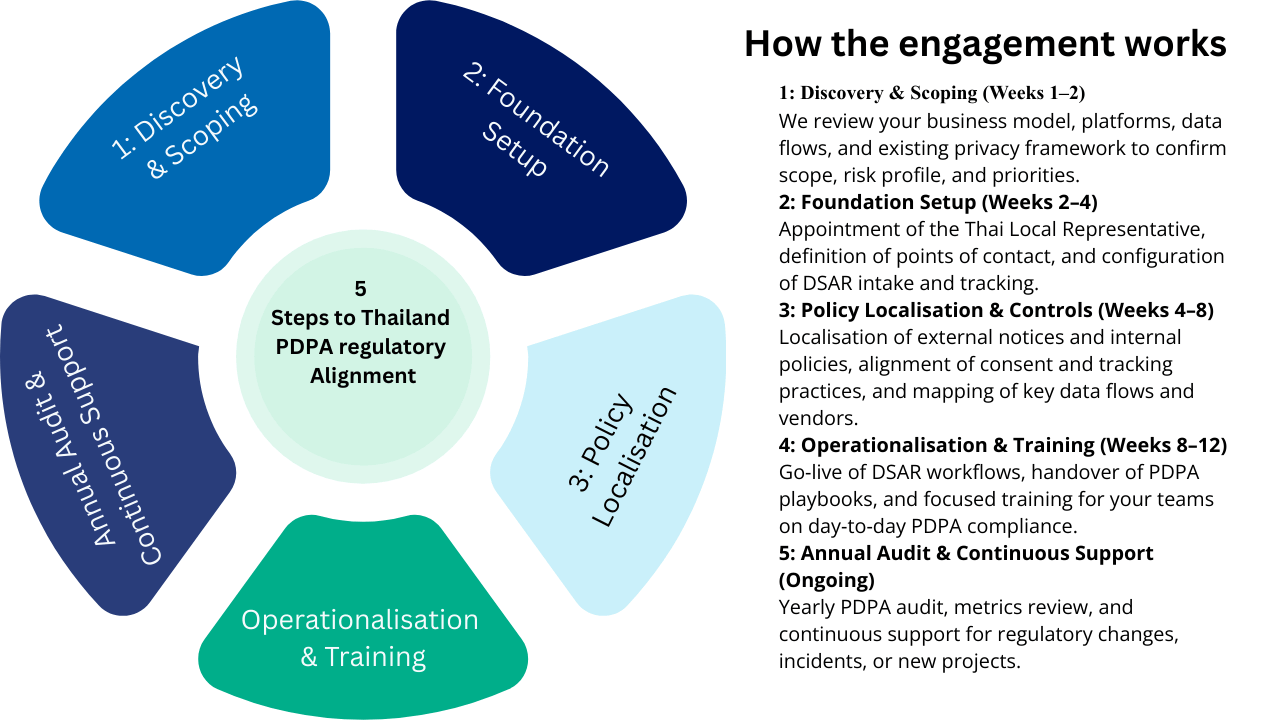
Formiti PDPA Structured Engagement Model
Service comparison table
Thailand PDPA service components
| Service component | What you get | Best suited for |
| Local PDPA Representative | In‑country contact for PDPC and data subjects, handling notices, complaints, and regulatory communications. | Organisations outside Thailand offering goods/services or monitoring Thai users. |
| DSAR / DSR Management | End‑to‑end workflow for access, rectification, erasure, and portability with tracking and audit trails. | High‑traffic apps, gaming, and retail with frequent user requests. |
| Policy Localisation & Onboarding | Thai‑ready privacy notices, consent language, and internal procedures aligned to PDPA. | New entrants or scaling brands entering or expanding in Thailand. |
| Annual PDPA Audit | Structured review of controls, gaps, and remediation roadmap, with management‑level reporting. | Established organisations needing demonstrable, ongoing compliance. |
| Cross‑Border & AI Add‑On | Data flow mapping, transfer documentation, and PDPA‑aligned AI and profiling guidance. | Data‑driven and AI‑enabled businesses operating multi‑jurisdictional services. |
Secure Your Thai Market Access with Confident PDPA Compliance
Quick Links
About Us
Services
Projects
Blog
Contact Us
Branch Offices
Ireland 6 Fern Road, Sandyford, Dublin, D18 FP98, Ireland
Switzerland Chamerstrasse 172, 6300 Zug (eigene Büros)
Thailand Village Chai Charoen Ville Project 7 88/103 Village No. 8, Nakhon Sawan Tok, Subdistrict Mueang Nakhon Sawan Province 60000, Thailand
Headquarters
Grosvenor House, 11 St Pauls Square, Birmingham B3 1RB, United Kingdom
+44 (0) 1215820192
Follow Us