
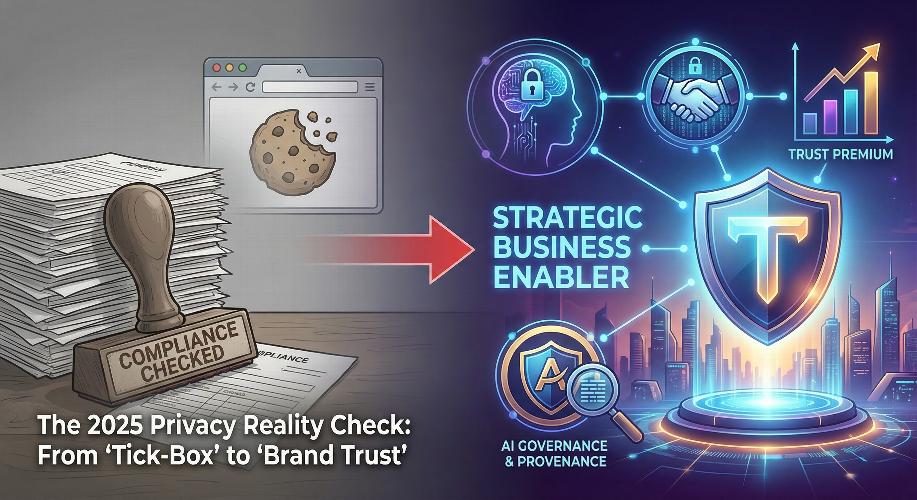
The 2025 Privacy Reality Check – From “Tick-Box” to “Brand Trust”
In the early 2020s, data privacy was often treated as a “legal tax”—a series of checkboxes to satisfy auditors and avoid the dreaded GDPR fines. But as we move through 2025, the landscape has shifted fundamentally. Privacy is no longer a static target or a back-office compliance hurdle; it is a core business differentiator.
With the full implementation of the EU AI Act and a complex patchwork of U.S. state laws spanning from Iowa to Minnesota, the “one-and-done” compliance mindset is officially dead. Today’s buyers of privacy consulting aren’t just looking for legal cover; they are looking for a competitive edge.
1. The AI Governance Convergence
Privacy is now inseparable from Artificial Intelligence. In 2025, consultants are no longer just looking at spreadsheets of personal data; they are assessing Data Provenance.
As organizations integrate Generative AI into their workflows, the “garbage in, garbage out” rule has a legal twist: “Illegal in, liability out.” Modern privacy partners must verify where your AI training data originated and whether it was obtained with valid consent. If your consultant isn’t discussing AI model transparency and algorithmic bias alongside traditional data protection, they are giving you half a map.
2. The Death of Third-Party Cookies
The “Cookie-pocalypse” has finally matured. As AdTech shifts heavily toward first-party and zero-party data, privacy is now a marketing stakeholder.
Your privacy partners must help you build “Consent-Aware” marketing stacks. The goal isn’t just to show a legal notice; it’s to build a high-trust user journey where customers want to share their data because they see the value exchange. Privacy-preserving measurement and “Clean Rooms” are the new tools of the trade for revenue-focused privacy buyers.
3. Enforcement Intensity & Dark Patterns
Regulators have moved past the education phase. We are seeing aggressive penalty actions focused on two specific areas:
- Biometric Data: Mismanagement of facial recognition or fingerprint data is seeing some of the highest fines to date.
- “Dark Patterns”: Regulators are cracking down on manipulative UI/UX designs that trick users into consenting. If your consent flow is “too easy” to say yes to, it might actually be a legal liability.
From Operational Debt to Strategic Enabler
For years, privacy spend was viewed as Operational Debt—money spent to fix past mistakes or keep the lights on. In 2025, the narrative has flipped. Privacy is now a Strategic Business Enabler.
- Accelerating Deals: A robust privacy posture allows B2B companies to pass through vendor security assessments in days rather than months.
- Building Brand Equity: In a world of deepfakes and data leaks, “Privacy by Design” is a premium brand promise that allows companies to charge a trust premium.
- Data Quality: Good privacy practices lead to cleaner, more accurate data. When users trust a brand, they provide higher-quality information, which in turn leads to better business intelligence and AI performance.
Key Buyer Insight: When interviewing a firm today, ask for their AI ethics framework. If they only talk about GDPR articles and ignore AI model transparency, they are already behind the curve.
Q&A: Navigating the 2025 Landscape
Q: We are already GDPR compliant. Isn’t that enough for the U.S. market?
A: Not anymore. While GDPR is a great foundation, U.S. state laws (like those in California, Colorado, and now Minnesota) have specific requirements regarding “Opt-out of Sale/Sharing” and “Sensitive Data Processing” that differ from the EU model. 2025 requires a Global Privacy Framework that can be localized, not a “one-size-fits-all” approach.
Q: How does the EU AI Act affect my privacy consulting budget?
A: It expands it. You now need “AI Impact Assessments” which are more technical than traditional Data Protection Impact Assessments (DPIAs). Your consultants need to bridge the gap between your Data Science team and your Legal team.
Q: Is “Privacy-as-a-Service” (PraaS) better than hiring a one-time consultant?
A: For most mid-to-large organizations, yes. Because regulations now change quarterly rather than every few years, a “subscription” model ensures your Record of Processing Activity (RoPA) is always live, rather than a snapshot that is out of date the moment the consultant leaves the room.
Looking Ahead: What’s Next for 2026?
If 2025 was the year of “AI Readiness,” 2026 will be the year of “Algorithmic Accountability.” Here are the three major shifts you should prepare for in your next budget cycle:
1. The Era of “Agentic” AI Governance
In 2025, we mostly used AI to chat or summarize. In 2026, we are seeing the rise of AI Agents—autonomous systems that can make decisions and take actions (like purchasing, scheduling, or data processing) on behalf of users.
- The Challenge: How do you manage consent when an AI agent is the one making the data request?
- The Strategy: Your privacy partners will need to shift from “Notice and Choice” for humans to “API-Level Consent” for machines.
2. Full EU AI Act Enforcement & “High-Risk” Compliance
By August 2026, the EU AI Act’s requirements for “high-risk” systems (recruitment, credit scoring, healthcare) become fully enforceable.
- The Challenge: Traditional DPIAs (Data Protection Impact Assessments) will no longer be enough.
- The Strategy: Expect to conduct FRIA (Fundamental Rights Impact Assessments). If your current consultants haven’t started building these templates for you, your 2026 compliance is already at risk.
3. The Rise of “Geopatriation” and Sovereign Clouds
Due to intensifying geopolitical tensions and stricter “Data Sovereignty” laws, 2026 will see a massive shift away from centralized global clouds toward Regional Sovereign Clouds.
- The Challenge: Multi-national companies will struggle to keep a single “global” data lake.
- The Strategy: Your technical privacy partners must help you architect “Data Localization” strategies that allow for global insights without moving raw data across borders.
4. Privacy-Enhancing Technologies (PETs) Become Standard
In 2026, simply “encrypting” data will be the bare minimum. Regulators and enterprise buyers will expect PETs like:
- Synthetic Data: Using AI to create “fake” data that mimics real patterns for testing and training without privacy risk.
- Confidential Computing: Processing data in “black box” hardware environments where even the cloud provider can’t see it.
Final Thought for Buyers: The companies that win in 2026 won’t be those that avoided the biggest fines, but those that used privacy to build a “Trust Moat” around their customers.. Click here for a free professional consultation