Choosing between an interim DPO service and a day-rate contractor is one of the more consequential decisions a multinational compliance function will make in 2026 — and it's rarely as straightforward as comparing a monthly fee to a daily rate. For organisations operating across multiple jurisdictions, the real question is whether an outsourced data protection officer engagement gives you a single capable individual or a structured governance infrastructure that can withstand regulatory scrutiny in Bangkok, Bern, and Brussels simultaneously.
The stakes are rising. Supervisory authorities across the EU, UK, Switzerland, and Southeast Asia are increasing enforcement activity, and the expectations placed on the DPO role — whether internal or external — have expanded well beyond advisory. Regulators want evidence: documented assessments, defensible transfer mechanisms, incident records, and audit trails that outlive any one person's tenure.
This article sets out the structural differences between the two models, compares them across the criteria that matter most to Legal, compliance, and IT leadership at multinational organisations, and gives you a clear framework for selecting the right approach for your 2026 regulatory footprint.
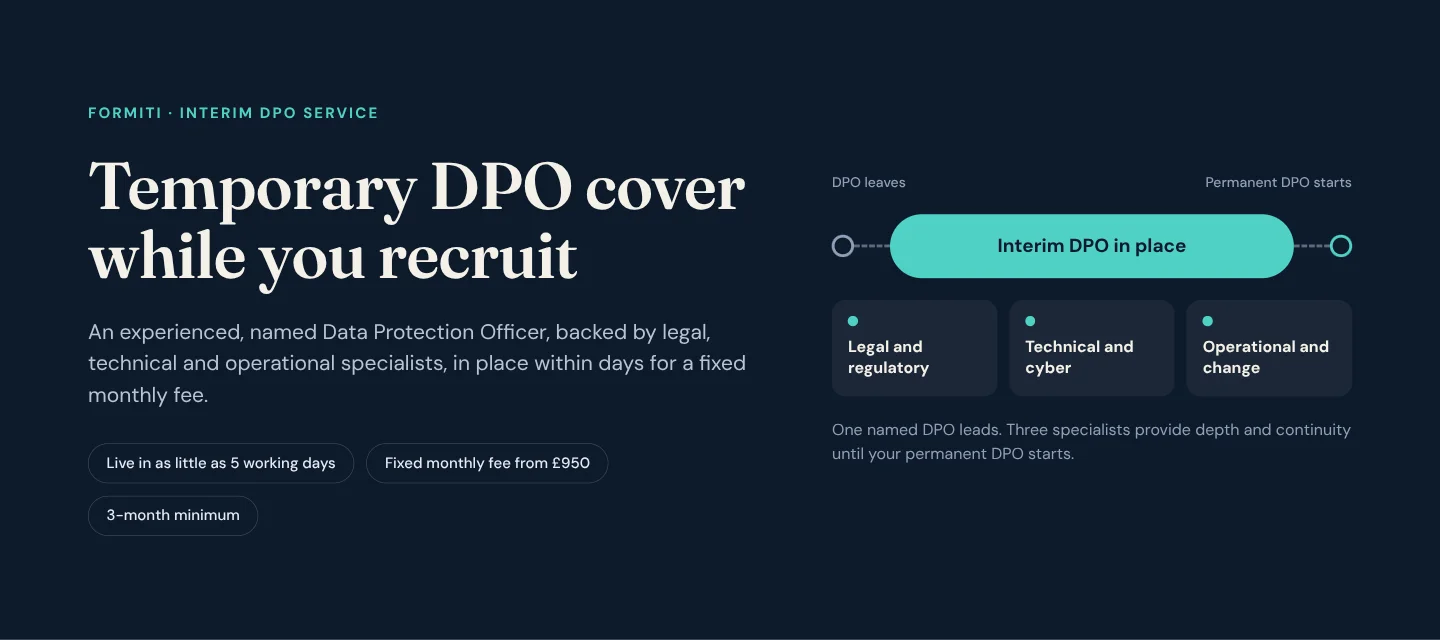
Need cover now? Formiti's Interim DPO Service puts a named DPO, backed by legal, technical and operational specialists, in place within days for a fixed monthly fee.
Defining the Models: Interim DPO Services vs Day-Rate Contractors
Before comparing cost, compare structure. The two dominant models for filling a data protection leadership gap differ less in the calibre of the individual sitting in the role and more in what stands behind that individual when a regulator in Bangkok, Bern, and Brussels asks the same question in three different formats. That structural difference is what determines whether your compliance position survives the engagement. Understanding what each model actually delivers is the necessary starting point.
An interim data protection officer engaged through a managed service brings a firm-level infrastructure — legal counsel, privacy architects, and technical operations — behind a named lead. A day-rate contractor brings personal expertise, which may be considerable, but remains bounded by one person's experience and availability. The distinction matters most when a supervisory authority asks for evidence that spans multiple jurisdictions simultaneously.
External provision is no longer the exception. Around 28% of DPOs in the EEA are now external service providers rather than internal employees, and average pay for privacy and digital governance roles in the UK is around £75,000 — a figure that reframes the build-versus-buy question for most multinationals. At that cost baseline, the question is not simply whether to externalise, but which external model delivers the governance depth your regulatory footprint actually demands.
Interim DPO Service
A managed outsourced DPO engagement where a named lead is supported by a broader team of legal, architectural, and operational specialists. Continuity is contractual rather than personal: holiday, illness, resignation, or escalation are absorbed by the provider. The knowledge base is collective, so precedent from one jurisdiction informs decisions in another — and the firm's institutional record, not any one individual's memory, holds the evidence your regulators will ask for. This model ensures your outsourced DPO is backed by the infrastructure required to maintain audit-ready compliance across 120+ jurisdictions.
DPO Contractor
An independent professional engaged on a fixed-term, day-rate basis, typically through a staffing intermediary. Accountability sits with one person, which means the quality and breadth of DPO services delivered is bounded by that individual's personal experience and availability. The engagement is well-suited to defined, bounded tasks — such as a records-of-processing refresh, a single-market readiness review, or maternity cover in one entity — but it is not structured to deliver the cross-border DPO services that multinational organisations require when regulatory scrutiny spans multiple supervisory authorities simultaneously.
Cross-Border Regulatory Alignment
Harmonising privacy obligations across divergent frameworks — GDPR, Thailand's PDPA, Switzerland's nFADP, and dozens more — demands more than individual expertise. It requires a structured methodology that translates a single assessment, register, or transfer mechanism into defensible evidence across multiple supervisory authorities without duplicated effort. This is where the two models diverge most sharply. A day-rate contractor applies personal judgement to each new jurisdiction, which creates inconsistency as your footprint grows. A managed interim DPO service applies collective precedent: what the firm has already filed, argued, and defended in one market informs the approach in the next. Outsourced DPO costs are often evaluated too narrowly at this stage. Organisations that focus solely on the monthly service fee miss the embedded value of cross-border representation, local filing capability, and a governance platform that holds evidence across every jurisdiction simultaneously.
When you account for the internal management time, platform licensing, and re-onboarding costs that accompany a contractor model, outsourced DPO costs through a managed service are typically more stable and more proportionate to the regulatory scope they cover. For multinationals operating across 120+ jurisdictions, cross-border regulatory alignment is not a project — it's an ongoing operational discipline. The model you choose must be capable of sustaining it.
Managed Governance Platforms
The technology layer that separates a modern outsourced data protection officer from traditional individual consulting: a central system of record holding assessments, registers, incidents and evidence. Critically, the DPO role is not just about advice; it is about ensuring the strategy is operationalised through technical operations and privacy architecture.
Head-to-Head Comparison: Outsourced Data Protection Officer Service Model vs Individual Contractor
When evaluating an interim data protection officer engagement against a day-rate contractor, the comparison rarely comes down to a single line on a budget spreadsheet. The criteria below are the factors that actually drive the decision. Day rate alone rarely does.
| Model | Accountability | Jurisdictional Reach | Tech Enablement | Cost Structure |
|---|---|---|---|---|
| Interim DPO Service | Firm-level; contractual SLAs, named lead with a supporting bench | Multi-regional by design, including local representation and filings | Proprietary governance platform included; evidence retained by the client | Fixed monthly or annual fee; predictable, scales by scope |
| Day-Rate Contractor | Individual; single point of failure if they exit or are unavailable | Limited to that person's lived experience, usually one or two regimes | Uses the client's existing tooling, however fragmented | Daily rate, exposed to market demand and utilisation creep |
| In-House Hire | Individual, with internal escalation but no external redundancy | Strong on home market, thin on everything else | Dependent on internal budget approval for any platform | Salary plus employer costs, benefits and tooling |
The sharpest divergence is knowledge breadth. A contractor brings what they have personally done; a managed interim data protection officer service brings what the firm has collectively filed, argued, and defended across dozens of markets. For a group operating in twenty or more jurisdictions, that difference surfaces the first time a question falls outside the contractor's home regime — and it will.
Cost comparisons are often done poorly. A DPO contractor day rate looks competitive against a monthly service fee until you add platform licensing, internal management time, onboarding, and the cost of re-establishing context when the contract ends. When measured properly, outsourced DPO costs are typically more stable and predictable, as the provider absorbs utilisation risk and delivers continuity as a contractual obligation rather than a personal courtesy. Against average UK pay of around £75,000 for privacy roles, both external models are defensible — but only one of them is priced per outcome rather than per day.
Strategic Considerations for Multinational Organisations
For multinational organisations, the choice between an interim DPO service and a day-rate contractor isn't primarily a budget decision — it's a governance architecture decision. The criteria below reflect what actually matters when your regulatory footprint spans multiple supervisory authorities. Scalability: Legal theory scales easily; operational reality does not. A lawful basis analysis that works for an EU processing activity must be re-expressed as a consent architecture in Thailand, a transfer assessment in Switzerland, and a localisation check across several Asian and Middle Eastern markets.
One person applying personal judgement to each new jurisdiction becomes the bottleneck as your footprint grows. An outsourced DPO engagement through a managed service distributes that work across specialists who already hold local precedent — so expansion into a new market triggers a configuration change, not a recruitment exercise. Continuity: Regulatory drift is a subtle but serious risk. When a contractor's term ends, the reasoning behind a transfer decision, a DPIA conclusion, or a retention schedule frequently leaves with them — held in a personal spreadsheet or an email thread rather than an institutional record. The successor rebuilds from scratch, often introducing inconsistencies that surface only under regulatory scrutiny.
A managed outsourced DPO service carries continuity as a contractual obligation. Handover is a deliverable, documentation is held at firm level, and audit-ready evidence outlives the tenure of any individual in the role. Technology: The Three-Team Methodology — legal counsel, privacy architects, and technical operations working from a shared record — is structurally impossible to replicate in a single hire. Legal interpretation without architecture produces policies that nobody implements. Engineering without legal interpretation produces controls that nobody can defend.
Formiti Consulting's Privacy360 governance platform closes that gap by holding assessments, registers, incidents, and evidence in a single system of record across all active jurisdictions. A day-rate contractor, by contrast, works within whatever tooling your organisation already has — however fragmented — and takes their working knowledge with them when the engagement ends. Cross-Border Representation: Supervisory authorities in the EU, UK, Switzerland, and Thailand don't ask the same question in the same format. Local representation — the ability to file, respond, and engage with each authority in the terms they expect — requires more than one person's experience of one regime.
An outsourced DPO model built for multinational organisations embeds that representation as a standard capability, not an add-on. For organisations operating across 120+ jurisdictions, that distinction is the difference between a defensible compliance position and one that holds only until the first cross-border inquiry.
Scalability
When your regulatory footprint grows, DPO services delivered through a managed outsourced model scale with it — a day-rate contractor does not. A lawful basis analysis that works for an EU processing activity must be re-expressed as a consent architecture in Thailand, a transfer assessment in Switzerland, and a localisation check across several Asian and Middle Eastern markets. One person applying personal judgement to each new jurisdiction becomes the bottleneck as your footprint expands.
A managed interim DPO service distributes that work across specialists who already hold local precedent. The firm's collective knowledge base — built from assessments already filed, argued, and defended across dozens of markets — means expansion into a new jurisdiction triggers a configuration change, not a recruitment exercise. Global impact: Scaling your DPO services through a structured managed model means your compliance infrastructure grows with your business, without the delays, gaps, or re-onboarding costs that accompany each new contractor engagement.
Continuity
Regulatory drift poses a subtle risk. When a contractor's term ends, the reasoning behind a transfer decision, a DPIA conclusion or a retention schedule often leaves with them — sitting in a personal spreadsheet or an email thread rather than an institutional record. The successor rebuilds, often resulting in inconsistencies. Interim dpo services backed by a firm carry continuity obligations: handover is a deliverable, not a courtesy.
Global impact: Audit-ready documentation must outlive the tenure of any individual holding the role.
Technology
When evaluating a DPO contractor day rate against a managed interim DPO service, technology infrastructure is one of the sharpest points of divergence — and one of the most underweighted in procurement decisions. A day-rate contractor typically works within whatever tooling your organisation already has in place: shared drives, spreadsheet registers, and email threads that hold reasoning no regulator can easily interrogate.
When the engagement ends, that evidence leaves with the individual or remains scattered across systems that were never designed to support cross-border audit readiness. Formiti Consulting's Privacy360 platform operates differently. It functions as a central system of record — holding assessments, processing registers, transfer mechanisms, incident logs, and DPIA conclusions in a single, queryable environment that spans every jurisdiction simultaneously. Evidence is institutional, not personal.
When a supervisory authority in Bangkok, Bern, or Brussels requests documentation, the answer is already structured and retrievable — not reconstructed from memory or a departing contractor's files. The Three-Team Methodology — legal counsel, privacy architects, and technical operations working from the same record — is what makes this possible at scale. Legal interpretation without architecture produces policies nobody implements. Engineering without legal grounding produces controls nobody can defend. Privacy360 holds both in one place, so that an assessment written by a lawyer becomes a tracked control owned by an engineer, visible across the full regulatory footprint.
Global impact: Governance evidence becomes an institutional asset under your control — queryable across 120+ jurisdictions at once, rather than reconstructed per audit or lost when a DPO contractor day rate engagement concludes.
The Bottom Line: Selecting Your 2026 DPO Strategy
Align the model with the scope of your regulatory footprint, rather than the size of the immediate gap.
- Day-rate contractors are the right call for short, bounded, single-region work — a records remediation project, a defined audit response, or cover for a departing in-house lead in one market where the regulatory scope is already understood.
- A managed interim data protection officer is necessary once you need multi-regional representation, local filings and a single pane of glass across entities, because no individual carries defensible depth in dozens of regimes simultaneously.
- Prioritise providers with an integrated governance platform so that registers, assessments and incident evidence remain institutional property rather than a departing contractor's spreadsheet.
- Test whether the model closes the gap between legal advice and technical implementation before you sign — ask who writes the control, who builds it, and who proves it worked.
The decision is better framed as a change of category than a change of supplier: you are moving from hiring a person to implementing a global governance infrastructure. Formiti Consulting delivers that through Global Privacy & AI Governance Managed Services, including outsourced DPO, cross-border representation, and the Privacy360 governance platform, applying the Three-Team Methodology of legal, architects and technical operations to deliver audit-ready compliance across 120+ jurisdictions. An individual contractor, however capable, cannot supply three disciplines and a system of record at once.
To scope an outsourced dpo engagement against your current jurisdictional footprint, speak to Formiti about interim DPO cover and global representation.
Compare tiers, use the cost-saving calculator and book a call on the Interim DPO Service page.