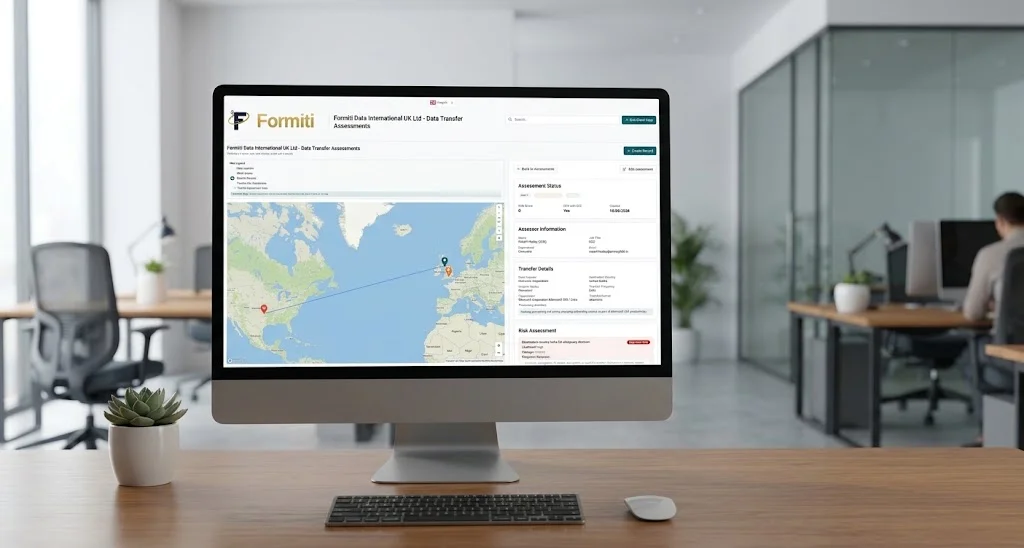
Cross-border data transfer compliance is the discipline of ensuring that personal data moving between jurisdictions does so on a lawful, documented, and defensible basis. Standard contractual clauses — pre-approved contract terms that bind the data importer to defined protection obligations and enforceable data subject rights — are the most widely used mechanism for achieving that lawful basis, particularly when transferring data to countries without an EU adequacy decision. For multinational organizations, getting this right isn't optional: most modern privacy frameworks, including GDPR, attach obligations to where the data subject is located, not where your company is headquartered.
If your organization operates across multiple markets, employs staff internationally, or relies on cloud infrastructure and third-party vendors, you are already conducting international data transfers. Remote access, backup replication, and support ticket routing all count — storage location alone doesn't resolve the compliance question.
This guide is designed for Legal, compliance, and IT leadership navigating that complexity. It covers the core regulatory frameworks, approved transfer mechanisms, operational checklists, and the failure modes that most commonly surface during regulatory review. Formiti Consulting's Three-Team Methodology — combining legal advisory, privacy architects, and technology operations — operationalizes each of these elements through the Privacy360 platform, delivering audit-ready compliance across 120+ jurisdictions.
The Fundamentals of Cross-Border Data Transfer Compliance
A cross border data transfer happens whenever personal data moves from one jurisdiction to another — a database replicated to a foreign cloud region, a support ticket read by an engineer in another country, or a payroll file sent to a regional service provider. Remote access counts. Storage location alone doesn't settle the question.
Compliance is mandatory because most modern privacy laws attach obligations to the data subject's location, not the company's. If you serve customers or employ staff abroad, you are already conducting international data transfers.
The core frameworks include GDPR Article 44, which prohibits transfers outside the EEA unless a recognized safeguard applies, alongside tightening US restrictions on bulk sensitive data reaching designated foreign states.
Distinguish two separate ideas: data localization requires information to stay physically in-country, while transfer permissions allow movement under defined conditions.
Need someone to own your transfer programme? Formiti's outsourced DPO service provides a named DPO who maintains your transfer register, TIAs and SCCs across 120+ jurisdictions.
Understanding Modern Regulatory Frameworks
Modern cross-border data transfer compliance doesn't operate under a single rulebook — it operates under a layered set of frameworks that interact, conflict, and evolve on different timelines. Understanding how they fit together is the foundation of any defensible transfer program.
The EU's adequacy decision mechanism permits transfers to a limited set of approved countries without additional contractual safeguards. Those decisions are subject to periodic review and can be suspended — as the original Privacy Shield demonstrated — which means organizations relying on adequacy alone need a documented fallback mechanism for every critical data flow.
In the United States, Department of Justice rules restrict bulk transfers of sensitive personal data to designated countries of concern and covered persons. This is a national security framework, not a privacy one, and it operates alongside GDPR obligations rather than replacing them for multinational organizations.
China's PIPL takes a third path: mandatory security assessments, state approval requirements, and localization duties for critical information infrastructure operators. Organizations with operations or data subjects in China face obligations that standard contractual clauses alone cannot satisfy.
Across all three frameworks, a transfer impact assessment is the mechanism that connects legal theory to operational reality. Before relying on any transfer mechanism, organizations must evaluate the destination country's surveillance laws, the importer's practical ability to honor contractual commitments, and the residual risk that supplementary measures are designed to address. Formiti Consulting's Three-Team Methodology — combining legal advisory, privacy architects, and technology operations — embeds transfer impact assessment into the compliance workflow rather than treating it as a one-time exercise, ensuring that regulatory shifts in any jurisdiction are caught and addressed before they create exposure.
Defining Personal Data in a Global Context
Personally identifiable information covers anything that identifies a person directly or indirectly — a name, an employee ID, a device fingerprint, or a combination of attributes that singles out an individual. Sensitive categories — health records, biometrics, genetics, precise geolocation, and financial detail — carry heightened restrictions in nearly every jurisdiction and demand stricter controls at every stage of processing.
This distinction becomes operationally critical when planning cross-border data transfers. The same data element may be classified as personal data under GDPR, fall into a gray zone under another framework, or trigger sector-specific rules depending on the destination. Metadata and IP addresses, for example, are treated as personal data under EU law but sit in a less defined position elsewhere — a gap that complicates any attempt to apply a single uniform policy across a multinational footprint.
Clinical trial results, genomic files, and account-level financial records should be classified as high-risk by default and mapped separately from routine business data. Without that granularity in your data inventory, transfer impact assessments lack the precision regulators expect, and the legal mechanisms you select may not match the actual sensitivity of what's moving across borders.
Implementing Approved Legal Transfer Mechanisms
Once you know where data goes, you need a lawful route for each destination.
Standard contractual clauses are the workhorse for third-party transfers — pre-approved contract terms binding the importer to defined data protection duties and enforceable rights for data subjects. They suit vendor relationships, cloud providers, and processors.
Binding corporate rules govern intra-group flows. A multinational with entities across dozens of markets can move data internally under a single approved rulebook rather than papering every affiliate pair.
The EU-U.S. Data Privacy Framework operates as the privacy shield replacement, letting certified US recipients receive EU data without separate clauses — provided certification stays current and the underlying adequacy decision survives review.
Legal certainty runs highest where adequacy or approved BCRs apply. Where neither exists, an SCC data transfer backed by documented supplementary measures remains the practical default.
Utilizing Standard Contractual Clauses (SCCs)
Select the module that matches the actual relationship: controller-to-controller, controller-to-processor, processor-to-processor, or processor-to-controller. Misclassification invalidates the instrument.
Where destination law undermines the clauses, add supplementary measures — encryption with keys held outside the jurisdiction, pseudonymization, or contractual transparency commitments.
Recurring failures: unsigned annexes, stale sub-processor lists, and modules copied from an unrelated contract without adjusting the technical descriptions.
Leveraging Binding Corporate Rules (BCRs)
BCRs are one of the recognized safeguards under GDPR Article 44, which prohibits transfers of personal data outside the EEA unless a lawful mechanism applies. For multinational groups with sustained intra-company flows, BCRs offer a durable alternative to executing bilateral clauses between every affiliate pair — but they require a functioning governance structure and the internal resources to sustain ongoing audits and regulatory oversight.
Approval runs through a lead supervisory authority and takes considerably longer than executing standard contractual clauses. This is a compliance program, not a document — it demands defined accountability, internal enforcement mechanisms, and a process for updating the rulebook as the group's structure or data flows change.
The operational payoff is most visible in HR and internal operations, where a single approved framework replaces a sprawl of bilateral agreements and gives regulators a coherent, auditable record of how intra-group transfers are governed across every jurisdiction the organization operates in.
Step-by-Step Compliance Checklist for International Transfers
Start with data mapping. Identify every system, vendor, and support pathway where information crosses a border, including remote administrative access and backup replication. Unmapped flows are the most common audit finding.
Next, run a transfer impact assessment for each destination, weighing local surveillance powers, judicial redress, and the importer's practical ability to resist unlawful access requests.
Then document the legal basis for each transfer inside your Article 30 records of processing. Regulators expect the mechanism, the destination, the data categories, and the safeguards to be traceable in one place.
Finally, apply technical safeguards. End-to-end encryption, pseudonymization, strict access logging, and role-based restrictions reduce the exposure a legal instrument alone cannot eliminate.
Treat the checklist as a cycle. Each new vendor, region, or product feature restarts it.
Conducting a Transfer Impact Assessment (TIA)
A defensible transfer impact assessment template should capture:
- Surveillance and government access laws in the recipient country, including scope and available remedies
- The importer's technical and organizational capacity to honor the chosen mechanism
- Data categories, volume, sensitivity, and retention period
- Supplementary measures applied and their residual effectiveness
- Review dates, decision owners, and the evidence supporting each conclusion
Undocumented reasoning fails the accountability test regardless of how sound the analysis was.
Technical Safeguards and Data Security
Technical safeguards are a necessary complement to the legal instruments governing international data transfers — a well-drafted SCC doesn't prevent unauthorized access; encryption and access controls do.
Zero-trust architecture — verify every session, enforce least privilege, log continuously — limits what a cross-border support engineer can actually reach, regardless of where they're located. Apply it to any system that handles personal data moving across jurisdictions.
When evaluating your transfer architecture, weigh in-country data residency against encrypted transit with strong access controls. Residency resolves some jurisdictional questions but introduces cost, fragmentation, and operational complexity at scale. For most multinational organizations, encrypted transit with rigorous access governance is the more sustainable model.
Where transit is the answer, hold decryption keys in a neutral jurisdiction so the importer cannot unilaterally disclose readable data in response to a local government request. Pair that with role-based access restrictions, pseudonymization where feasible, and audit logging that creates a traceable record of who accessed what and when. These controls don't replace your legal transfer mechanism — they make it defensible.
Managing Specialized Data Scenarios Across Borders
Generic transfer policies break down at the edges, and the edges are where enforcement concentrates.
Clinical trial data moves between sponsors, CROs, labs, and regulators across multiple countries, carrying health data, genetic information, and pseudonymized subject identifiers, under overlapping research and privacy rules.
Confidential HR data presents a quieter but broader problem. Performance reviews, disciplinary records, immigration documents, and compensation data flow to headquarters systems continuously, often without anyone classifying the transfer at all.
Employer of Record arrangements shift employment liability but rarely eliminate controller status. If you determine why and how employee data is processed, GDPR obligations follow you regardless of who signs the local contract. A named outsourced DPO service can own that accountability across every jurisdiction you operate in.
Foreign law enforcement requests need a standing protocol: route through legal, verify jurisdiction and legal basis, notify the exporter where permitted, and disclose the minimum required. Improvised responses create precedent you'll later defend.
Clinical Trial and Healthcare Data Compliance
HIPAA governs covered entities in the U.S. and their business associates; GDPR governs the data of people in the EEA regardless of sector. International research frequently triggers both, and the stricter requirement controls.
Secondary use of trial data demands consent language specific enough to cover future analysis and transfer destinations. Keep protocol versions, consent forms, and transfer logs aligned so health authority inspections find one coherent record.
Human Resources and EOR Compliance Patterns
Global payroll providers frequently act as joint controllers rather than pure processors — a distinction that directly affects which data transfer rules apply and which party bears accountability for each processing activity. Establish the allocation of responsibilities in writing before the first payroll cycle, not after a subject access request arrives.
Remote employees based in countries of concern require additional scrutiny. Audit what corporate systems they can reach, document the legal basis for any cross-border access, and apply role-based restrictions that limit exposure to sensitive HR records.
For centralized HR databases, restrict access by region and role, log every cross-regional query, and ensure your Article 30 records reflect the actual flow of employee data across jurisdictions. Employer of Record arrangements add a further layer: the EOR typically processes payroll, benefits, and employment records on behalf of the client organization, which means data transfer rules govern every routine HR transaction — not just exceptional disclosures. Map those flows explicitly and confirm that the mechanism in place covers the full scope of processing, not just the initial onboarding data exchange.
Common Failure Modes and Operational Fixes
The dominant failure is the set-and-forget mentality. Clauses get signed, a folder gets filed, and nobody revisits the arrangement while the vendor changes sub-processors, the product adds a new cloud region, and the destination's legal environment shifts.
Shadow IT compounds it. A team adopts a collaboration tool with a company card, uploads customer data, and creates an undocumented transfer that no contract covers and no assessment evaluated.
Automated governance closes the distance between written policy and actual data movement. Continuous discovery, vendor inventories, linked assessments, and dated evidence turn compliance from a periodic scramble into a monitored state — the function Privacy360 performs inside Formiti Consulting's managed services.
Geopolitics adds the final variable. Adequacy decisions are political instruments as much as legal ones, and a change in alliance or a court ruling can invalidate a route you depended on. Maintain a documented fallback mechanism for every critical flow.
The Risk of Shadow IT in Global Teams
Unauthorized SaaS adoption is one of the most consistent sources of undocumented cross-border data flows in multinational organizations. When regional teams onboard tools outside procurement review, vendor due diligence doesn't happen, transfer impact assessments don't get run, and the data crosses borders before anyone has classified what it is or established a lawful basis for the transfer. Neither standard contractual clauses nor binding corporate rules can protect a flow that compliance teams don't know exists.
Discovery requires active investigation, not passive monitoring. Effective methods include expense report analysis, network egress monitoring, SSO and identity provider logs, and direct interviews with regional business units — the teams most likely to have adopted tools independently to solve a local problem quickly.
The structural fix is embedding Privacy by Design into procurement before tools reach production. Every new vendor relationship should trigger a transfer basis review as a condition of approval, not an afterthought. Where intra-group flows are involved, that review should confirm whether the organization's binding corporate rules cover the new processing activity or whether a gap needs to be addressed before deployment. Formiti Consulting's Three-Team Methodology operationalizes this gate through the Privacy360 platform, giving compliance teams a traceable record of every tool, every data flow, and every approved transfer mechanism across the organization's full jurisdictional footprint.
Maintaining Audit-Ready Documentation
Annual reviews no longer match the pace of regulatory change. Continuous monitoring — triggered by new vendors, new regions, and new legal developments — is the operating standard.
Automated platforms generate dated, versioned reports that show a regulator what you knew and when you knew it.
Accountability means producing evidence on demand: assessments, decisions, owners, and remediation history, not a policy statement.
Limitations and Strategic Considerations
No transfer mechanism eliminates risk. Clauses bind the importer but cannot override a foreign government's lawful access powers, and adequacy can be withdrawn. The realistic objective is documented, proportionate risk reduction — defensible, not perfect.
Localization trades efficiency for certainty. Regional data centers simplify the legal analysis while fragmenting analytics, slowing product rollouts, and multiplying infrastructure cost. That trade favors localization in heavily regulated sectors and disfavors it for low-sensitivity workloads.
Data minimization deserves more weight than it usually receives. Data never collected requires no transfer basis, no assessment, and no supplementary measures. Reviewing collection scope often removes more risk than any contract.
Political instability affects duration. A five-year vendor agreement may outlive the legal framework that justified it, so build review triggers and exit rights into every cross-border contract.
Localization vs. Global Flow Trade-offs
Strict data localization eliminates cross border data transfer risk for a specific flow, but it introduces real operational costs: duplicated infrastructure, regional licensing, parallel security tooling, and staffing overhead that compound as your footprint grows.
Residency requirements also create product and service asymmetries. Features that depend on centralized AI models, global analytics pipelines, or shared support infrastructure may ship late or be unavailable in restricted regions — a competitive and operational disadvantage that compounds over time.
The practical question for each flow isn't philosophical. Ask directly: does the business value of moving this data across borders exceed the legal exposure, the cost of the required safeguards, and the burden of defending that decision to a regulator?
For most multinational organizations, the answer varies by data category and destination. Routine operational data — anonymized telemetry, aggregated reporting, non-sensitive HR records — can typically move under documented transfer mechanisms without localization. High-sensitivity categories, data subject to sector-specific rules, or flows into jurisdictions with aggressive government access regimes may warrant residency as a risk control rather than a compliance formality.
Formiti Consulting's Privacy360 platform maps each data flow against its jurisdictional risk profile, so Legal and IT leadership can make that trade-off on evidence rather than assumption — and document the reasoning in a form that holds up under regulatory review.
When This Isn't the Right Approach
Genuinely anonymized data — irreversibly stripped of identifiability, not merely pseudonymized — falls outside most transfer regimes entirely.
Where destination law mandates government access without meaningful redress, clauses may be legally insufficient no matter what supplementary measures you layer on.
The alternative is architectural: process locally, transfer only aggregated or statistical outputs, and keep identifiable records in-region.
Key Takeaways: The 2026 Compliance Outlook
Current data transfer rules reward organizations that treat gdpr cross-border data transfer obligations as an operational discipline rather than a legal formality. Countries of concern designations, national security screening, and assessment-driven justification now sit alongside the traditional contractual toolkit.
Mapping comes first. You cannot select a mechanism for a flow you haven't identified, and most enforcement exposure lives in the flows nobody documented.
For IT and Legal leadership, the practical next steps are concrete: complete a current data flow inventory, assign a mechanism and assessment to every cross-border route, close shadow IT gaps at procurement, and set review triggers tied to regulatory change rather than the calendar.
Formiti Consulting closes the gap between legal theory and operational reality by combining expert advisory with the Privacy360 platform, delivering audit-ready data transfer compliance across 120+ jurisdictions.
Final Compliance Summary
GDPR cross-border data transfer obligations don't resolve themselves through a single contract or a one-time assessment. SCCs remain the most accessible mechanism for most organizations, but they hold up only when supported by a rigorous, documented transfer impact assessment of the destination jurisdiction and the supplementary measures applied to each data flow.
Localization requirements are tightening in health, finance, and public sector markets — in several regions, demonstrable compliance is becoming a prerequisite for market access, not just a regulatory obligation.
Continuous monitoring, not annual review, now defines what audit readiness actually means. Regulatory decisions shift, vendor sub-processors change, and new data flows emerge with every product update or market expansion. Formiti Consulting's Three-Team Methodology — combining legal advisory, privacy architects, and technology operations — embeds that ongoing oversight into the compliance workflow through the Privacy360 platform, so your transfer program stays defensible across 120+ jurisdictions without requiring a full rebuild every time the regulatory landscape moves.
Frequently Asked Questions
Is GDPR still relevant in 2026? Yes. It remains in force and enforcement has intensified, particularly around international data transfers and documented accountability. Organizations that assumed GDPR scrutiny would ease have found the opposite to be true.
What is a transfer impact assessment, and do I need one? A transfer impact assessment (TIA) evaluates whether the legal mechanism you've chosen — typically standard contractual clauses — can actually protect personal data once it reaches the destination country. It examines local surveillance laws, the importer's practical ability to resist unlawful access requests, and the effectiveness of any supplementary measures you've applied. Using a structured transfer impact assessment template ensures you capture the right evidence and can demonstrate accountability to regulators. If you're relying on SCCs to transfer data outside the EEA, a TIA isn't optional — it's the documented reasoning that makes your chosen mechanism defensible.
What does cross-border compliance mean for smaller organizations? The same obligations apply, scaled to your footprint. Map your data flows, select the appropriate transfer mechanism for each destination, and document your decisions. Regulators don't grant exemptions based on company size — they expect proportionate but complete records.
How do you manage confidential HR data across borders? Classify HR data as sensitive from the outset, restrict access by region and role, and cover intra-group movement under binding corporate rules or standard contractual clauses. Remote access by HR systems administrators in another country counts as a transfer and needs to be mapped and governed accordingly.
How does Formiti Consulting support cross-border transfer compliance? Formiti Consulting's Three-Team Methodology — combining legal advisory, privacy architects, and technology operations — embeds transfer impact assessments, SCC management, and ongoing monitoring into a single workflow delivered through the Privacy360 platform. The result is audit-ready compliance across 120+ jurisdictions, without the operational gaps that arise when legal analysis and technical implementation run on separate tracks.
Where to Look Next
Start with the national data protection authority in each jurisdiction where you operate. Authorities publish binding guidance, enforcement decisions, and country-specific interpretations that generic summaries miss — and their positions on transfers frequently diverge on detail.
The European Data Protection Board issues guidelines and recommendations that shape how supervisory authorities evaluate assessments and supplementary measures. Track its published opinions rather than relying on secondary commentary.
For sector-specific depth, academic and practitioner texts on international data law remain useful for understanding how conflict-of-laws principles apply to research, financial, and employment data.
Monitor government regulatory bulletins for changes to countries of concern designations and adequacy status. These move faster than most compliance calendars assume.
For organizations that would rather operationalize this than track it manually, Formiti Consulting provides Global Privacy & AI Governance Managed Services, including outsourced DPO, cross-border representation, and the Privacy360 governance platform. Start with a data flow review.