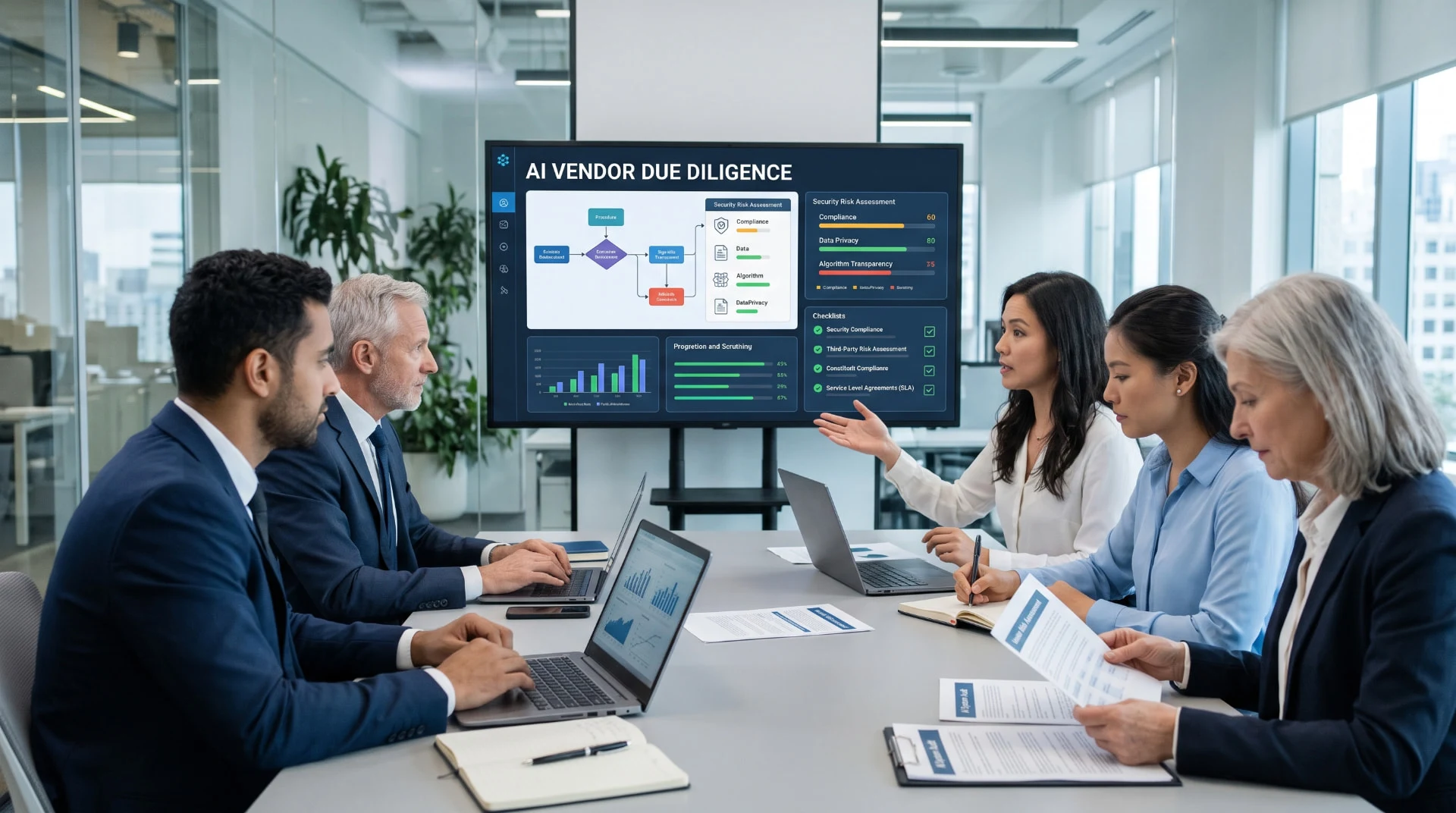
Most AI risk now enters through suppliers rather than in-house builds. Your CRM adds a copilot. Your recruitment platform starts ranking candidates. Your helpdesk tool ships a chatbot overnight.
Formiti Data International provides AI governance consulting and AI vendor risk assessment for evidence-based supplier reviews.
However, a standard vendor questionnaire was never designed for this. It asks whether a supplier is secure, solvent and reliable. It rarely asks where the model came from, what it was trained on, or who else sits in the chain.
Moreover, using a supplier's AI does not pass your legal duties to that supplier. Under the EU AI Act, you remain a deployer with your own obligations. Under UK and EU GDPR, you usually remain the controller. Regulators are also watching closely. For example, the ICO's audits of AI recruitment tools produced nearly 300 recommendations for providers and developers.
This guide therefore sets out the questions to ask before you sign. It focuses on three areas that generic forms skip: data provenance, the model supply chain and EU AI Act evidence. For the full assessment method, read our guide on how to run a defensible AI vendor risk assessment.
What is AI supplier due diligence?
Supplier due diligence is the evidence-based check you run before relying on a third party. AI supplier due diligence extends it to the model, its data and its behaviour.
In practice, it answers four questions:
- What AI is in the product? Name the features, the models and who built them.
- What data does it use? Cover both its training data and your data once it is live.
- What role do you play? Under the EU AI Act, you may be a deployer or, in some cases, a provider.
- Can the supplier prove its claims? Ask for documents, not reassurance.
When to run it
Run it before signing, at renewal and whenever a supplier adds or changes an AI feature. Silent model updates are common, so contract for notice of them.
Scale it to the risk
Not every tool needs the same depth. A grammar checker does not need the scrutiny of a CV-screening tool. Therefore, tier each use case first:
| Tier | Example | Depth of review |
|---|---|---|
| High | Recruitment screening, credit decisions, patient triage | Full questionnaire, documents, contract review, scheduled reassessment |
| Medium | Customer chatbot, internal copilot using personal data | Core questionnaire, DPA and training-data terms |
| Low | Spelling, translation of non-personal text | Short form and acceptable-use rules |
High-risk use cases under Annex III of the EU AI Act, such as employment and credit scoring, belong in the top tier.
Data provenance: what was the model trained on?
Data provenance is the record of where training data came from and on what terms. It matters because unlawful training data can become your problem.
For instance, a model trained on scraped personal data may breach UK GDPR transparency and lawful-basis rules. Equally, a model trained on unlicensed content can expose you to copyright claims over its outputs. Either way, the reputational damage lands on the brand the customer sees: yours.
Ask for a training data summary
First, ask for a summary of the main datasets and sources. Providers of general-purpose AI models must already publish one under Article 53(1)(d) of the EU AI Act, using the AI Office's template. So if your supplier builds on such a model, that summary should exist. Ask for it, together with the supplier's own fine-tuning data description.
Ask for proof of licensing
Next, ask how the supplier secured rights to copyrighted material. In particular, request:
- its copyright policy, which general-purpose model providers must keep under Article 53(1)(c);
- how it honours text-and-data-mining opt-outs;
- the licence types behind key datasets, such as commercial licences, open licences or public domain;
- whether it offers an IP indemnity for outputs, and on what conditions.
Ask how personal data was filtered
Finally, ask what happened to personal data during training. Good answers name specific methods, for example:
- PII detection and removal before training;
- de-duplication to cut memorisation of rare records;
- exclusion of special category data;
- testing for training-data leakage in outputs.
Vague answers such as "we take privacy seriously" are a red flag. Likewise, a refusal to describe sources at all should move the tool up a risk tier.
Nested due diligence: look beneath the wrapper
Many AI products are "wrappers". In other words, the supplier builds an interface and workflow on top of another company's foundation model. Your contract is with the wrapper, yet your data may travel to the model provider.
As a result, a supplier can pass your checks while its model provider would not. Nested due diligence closes that gap.
How to spot a wrapper
Ask the supplier directly whether it trains its own models. Then check its sub-processor list for model providers and cloud AI services. Also read its privacy notice and trust centre for named model partners.
What to check one level down
Once you know the underlying model, check:
- Data retention: how long the model provider keeps prompts and outputs;
- Training use: whether the provider can train on your data, and the default setting;
- Location: where processing happens, and the transfer mechanism for restricted transfers;
- Change control: whether the supplier can switch model provider without telling you;
- Flow-down terms: whether the supplier's contract with the provider matches its promises to you.
In addition, record the full chain in your AI register, using a platform such as Privacy360. That way, a change at any level triggers a review rather than slipping through.
EU AI Act evidence to request
If you deploy a high-risk AI system, you need evidence that the provider has met its duties. You also need enough information to meet your own.
The Digital Omnibus on AI moved the dates but kept the requirements. Annex III high-risk obligations now apply from 2 December 2027. Annex I obligations for AI in regulated products apply from 2 August 2028. Meanwhile, AI literacy and the prohibited practices already apply. So start collecting evidence now, at contract stage, when you have leverage.
From the provider
| Document | Why you need it |
|---|---|
| Instructions for use (Article 13) | You must use the system in line with them under Article 26 |
| Summary of Annex IV technical documentation | Shows intended purpose, data, accuracy and known limits |
| EU declaration of conformity (Article 47) | Confirms the provider completed conformity assessment |
| EU database registration (Article 49) | Confirms the system is registered where required |
| Post-market monitoring and incident process | Shows how the provider will tell you about serious incidents |
Providers do not have to hand over full Annex IV files to customers. Even so, a credible provider can share a summary of the parts that affect you.
For your own deployer duties
Under Article 26, deployers of high-risk systems must, among other things:
- use the system according to its instructions;
- assign trained staff to human oversight;
- ensure their input data is relevant and representative;
- monitor operation and report serious incidents;
- keep automatically generated logs for at least six months;
- inform workers before using high-risk AI in the workplace.
Therefore, ask the supplier how its product supports each one, for example through log export and override controls. Also check Article 25. If you rebrand the system or substantially modify it, you may become the provider yourself.
The AI supplier due diligence questionnaire
Use these questions as a starting point. Then add your own sector rules. For high-tier tools, ask for a document behind every answer.
| Domain | Question to ask | Evidence to request |
|---|---|---|
| AI inventory | Which features use AI, and which models power them? | Feature list, model names and versions |
| Model supply chain | Do you train your own models or build on a third-party model? | Sub-processor list naming model providers |
| Training data | What were the main sources of training and fine-tuning data? | Training data summary |
| Copyright | How did you secure rights to copyrighted content? | Copyright policy, licence types, IP indemnity |
| Personal data in training | How did you detect and remove personal data before training? | Description of filtering and leakage testing |
| Customer data use | Will our data train your models or anyone else's? | DPA clause, default opt-out setting |
| Regulatory role | Is this system high-risk under the EU AI Act? | Classification rationale, Article 13 instructions |
| Conformity | Has the system completed conformity assessment? | Declaration of conformity, registration |
| Accuracy and bias | How do you test accuracy and bias, and how often? | Latest test summary and metrics |
| Human oversight | What controls let our staff review or override outputs? | Product documentation or demo |
| Logging | What logs can we access, and for how long? | Log specification and retention period |
| Security | Which security controls cover the AI service? | SOC 2 or ISO 27001 scope, AI-specific threats covered |
| Change management | How will you notify us of model or provider changes? | Change notice clause and lead time |
| Incidents | What counts as an AI incident, and when will you tell us? | Incident policy and notice period |
| Exit | How do we get our data back and confirm deletion? | Exit plan and deletion certificate |
Score each answer as met, partly met or not met. Then weight the scores by risk tier. Any "not met" on training data or customer data use should block signature until it is resolved.
Turn findings into contract terms and monitoring
Due diligence only protects you if the findings reach the contract. So translate each gap into a clause, a control or a risk acceptance.
Clauses to negotiate
- No training on your data without your written consent.
- Model and sub-processor change notice, with a right to object.
- Audit and information rights covering the AI service, not just the platform.
- AI incident notice within a fixed period.
- Cooperation with your deployer duties, including log access and oversight support.
- IP and data protection indemnities that cover outputs.
- Exit and deletion, including data held by the model provider.
Keep watching after signature
AI products change faster than contracts. Consequently, a one-off review goes stale within months. Reassess high-tier suppliers at least yearly and after any major model change. Also track supplier announcements, since new AI features often arrive by product update.
Finally, keep the evidence. Auditors and regulators will expect a current AI register, completed questionnaires and proof of follow-up. A DPIA will also be needed where the processing is likely to result in high risk to individuals.
Frequently asked questions
What is supplier due diligence?
Supplier due diligence is the process of checking a third party before you rely on it. It typically covers security, finance, legal compliance and operational resilience. For AI suppliers, it also covers models, training data and regulatory role.
What is an AI vendor risk assessment?
An AI vendor risk assessment scores a supplier's AI against defined risk domains. It usually combines a questionnaire, document review and contract review. The result is a risk rating and an action plan.
Does the EU AI Act apply to UK companies?
It can. The Act applies when an AI system is placed on the EU market or its output is used in the EU. So UK companies with EU customers, staff or users should check their position.
Who is responsible if a supplier's AI breaks the law?
Responsibility is often shared. The provider carries provider duties. However, you keep your deployer and controller duties. That is why evidence gathered before signing matters.
How long does an AI supplier review take?
A low-tier review can take a day. A high-risk system with nested suppliers can take several weeks, mainly while waiting for documents.
Get expert help with AI supplier due diligence
Formiti runs AI supplier due diligence as part of our AI governance consulting service. We assess each supplier against its risk tier, review the DPA and contract, and record the results in your AI register. If you already use our Global Outsourced DPO Service, AI supplier reviews can sit within it.