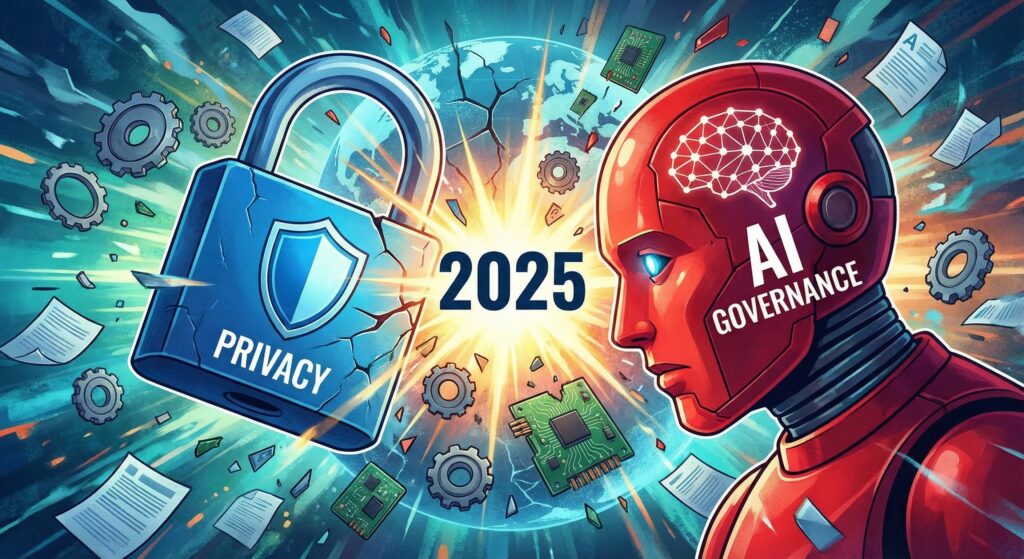
The Great Collision: Why 2025 is the Year Privacy and AI Governance Finally Crashed
By Rob Healey CEO Formiti Data International Date: January 2026
Introduction
For the last three years, we have been warned that the “AI Regulation Wave” was coming. In late 2025, it is no longer coming—it has crashed over us.
For global organizations, the comfortable silos of the past are gone. The Chief Privacy Officer (CPO) can no longer just look at personal data; they must now look at fundamental rights. The Chief Technology Officer (CTO) can no longer just ship code; they must now ship conformity assessments.
We are currently witnessing the “Great Collision”—the messy, high-friction overlap between established data privacy laws (like the GDPR and CCPA) and the newly enforced AI regulations. This collision is creating a new operational reality where “compliant” in New York might mean “illegal” in Berlin.
Here is why this is the single most critical subject for your organization today, and how to survive the impact.
The 3 Friction Points Defining Late 2025
1. The “Double Assessment” Trap: DPIA vs. FRIA
If your privacy team is exhausted by Data Protection Impact Assessments (DPIAs), brace yourself. The EU AI Act now enforces the Fundamental Rights Impact Assessment (FRIA) for high-risk systems.
The Conflict: A DPIA asks, “Is the data safe?” A FRIA asks, “Is the output fair?”
The Reality: You might have an HR recruiting tool that is perfectly GDPR-compliant (data is encrypted, access is restricted). But if that same tool biases against a specific demographic in its output, it fails the FRIA.
The Operational Drag: Global teams are currently reporting “assessment fatigue,” where product launches are delayed by weeks because Legal and Ethics teams are conducting parallel, duplicative reviews that don’t talk to each other.
2. The Trans-Atlantic “Rule of Law” Split
The dream of a unified global standard is dead. We are now operating in a bipolar regulatory world.
Europe (The Risk Model): The EU AI Act is fully enforceable. It categorizes AI by risk. If your AI is “High Risk,” you face heavy ex-ante (upfront) compliance obligations before you can even launch.
USA (The Patchwork Model): Instead of one federal law, we are navigating a minefield of state acts. Colorado’s AI Act (effective 2026) and California’s Automated Decision-Making rules focus on “consumer opt-outs” and “discrimination assessments.”
The Result: A global bank rolling out a credit-scoring algorithm now needs one version for the EU (heavy documentation, human oversight) and a slightly different version for the US (focused on disclosure and opt-out rights), destroying economies of scale.
3. The Return of “Shadow AI”
In 2023, “Shadow AI” meant employees secretly using ChatGPT. In 2025, “Shadow AI” is entire departments procuring AI agents that bypass IT governance entirely.
Because the new compliance rules are so heavy, marketing and HR departments are increasingly buying “compliance-free” tools from vendors who promise they “aren’t really AI” (even when they are).
This exposes the organization to massive third-party risk, as regulators have made it clear: you are responsible for the AI you buy, not just the AI you build.
Q&A: What Global Leaders Are Asking Right Now
Q: Can we just merge our Privacy and AI Governance teams?
A: You should merge their processes, not necessarily their people. Privacy lawyers are experts in data minimization. AI governance requires experts in model robustness and statistical bias. They are different skill sets, but they must use a Unified Intake Form. If you ask a developer to fill out two separate forms for the same project, they will lie on both to save time.
Q: We don’t sell AI. Does this affect us?
A: Yes. If you use AI to hire people (HR), score credit (Finance), or assess insurance claims, you are a “Deployer” of high-risk AI. Under the new laws, Deployers have almost as much liability as the companies that built the software. You cannot outsource your liability to Microsoft or Salesforce.
Q: What is the “Golden Rule” for 2026 planning?
A: “Inventory is Destiny.” You cannot govern what you cannot see. Most organizations still do not have a centralized, real-time inventory of every AI model running in their business. Building that registry is your Q1 2026 priority.
Conclusion: The Era of “Integrated Trust”
The “Great Collision” of 2025 is painful, but it is also a clarifying moment. It forces organizations to stop treating privacy, security, and AI ethics as separate chores.
The winners in this new landscape are the organizations that move to Integrated Trust. They are building a single “Control Tower” where a new digital project is assessed once for privacy, security, and AI risk simultaneously.
The regulations are complex, but the lesson is simple: In the age of AI, you cannot respect data if you do not respect the rights of the people behind it. For a free 30 minute consultation contact us here